Listen to the Andean cock-of-the-rock
Tip: press play to see the sound's live frequency spectrum in blue over the waveform.
About the Andean cock-of-the-rock
The Andean cock-of-the-rock is a bird in the family Cotingidae (order Passeriformes). Its conservation status on the IUCN Red List is “least concern”.
What does the Andean cock-of-the-rock sound like?
Most birds have two kinds of vocalisation: songs, which are learned or innate phrases delivered mainly in spring and summer, and calls – brief contact, alarm and begging notes heard all year round. Listening for both helps with identification.
The recordings here are labelled as lek song and male flutter. Listen for differences in rhythm, pitch and repetition – the spectrum display makes it easy to see whether a sound is a pure whistle (a thin line), a harsh call (a broad band) or a trill (rapid repeated marks).
From Wikipedia
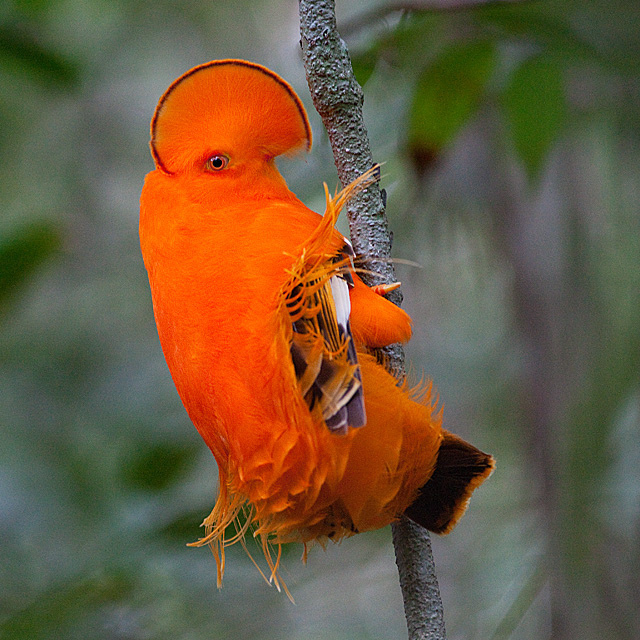
The Andean cock-of-the-rock (Rupicola peruvianus), also known as tunki (Quechua), is a large passerine bird of the cotinga family native to Andean cloud forests in South America. It is the national bird of Peru. It has four subspecies and its closest relative is the Guianan cock-of-the-rock.
The Andean cock-of-the-rock exhibits marked sexual dimorphism; the male has a large disk-like crest and scarlet or brilliant orange plumage, while the female is significantly darker and browner. Gatherings of males compete for breeding females with each male displaying his colourful plumage, bobbing and hopping, and making a variety of calls. After mating, the female makes a nest under a rocky overhang, incubates the eggs, and rears the young by herself.
Related birds in the genus Rupicola
More from the family Cotingidae

Amazonian umbrellabird
Cephalopterus ornatus

Screaming piha
Lipaugus vociferans

Red-crested cotinga
Ampelion rubrocristatus

Capuchinbird
Perissocephalus tricolor

Scaled fruiteater
Ampelioides tschudii
Long-wattled umbrellabird
Cephalopterus penduliger

Rufous piha
Lipaugus unirufus

Black-necked red cotinga
Phoenicircus nigricollis

Purple-throated cotinga
Porphyrolaema porphyrolaema

Orange-breasted fruiteater
Pipreola jucunda

Dusky piha
Lipaugus fuscocinereus
Frequently asked questions
What does an Andean cock-of-the-rock sound like?
You can hear 5 recordings of the Andean cock-of-the-rock on this page, including its lek song and male flutter. Most birds have two kinds of vocalisation: songs, which are learned or innate phrases delivered mainly in spring and summer, and calls – brief contact, alarm and begging notes heard all year round.
Is the Andean cock-of-the-rock endangered?
The IUCN Red List classifies the Andean cock-of-the-rock as “least concern”.
What family does the Andean cock-of-the-rock belong to?
The Andean cock-of-the-rock (Rupicola peruvianus) belongs to the family Cotingidae in the order Passeriformes.
Sources & credits
- Lek song · Napo: 'Cabañas San Isidro', 1-2 km SW Cosanga, Ecuador by Niels Krabbe – CC BY-SA 4.0 · Wikimedia Commons
- Lek song · Imbabura: Hda La Florida, Ecuador by Niels Krabbe – CC BY-SA 4.0 · Wikimedia Commons
- Lek song · Pichincha: ridge between Río Mindo and Río Nambillo, 3 km… by Niels Krabbe – CC BY-SA 4.0 · Wikimedia Commons
- Male flutter · Morona-Santiago: w-slope Cord. de Cutucú, Ecuador by Niels Krabbe – CC BY-SA 4.0 · Wikimedia Commons
- Lek song · Imbabura: Hda La Florida, Ecuador by Niels Krabbe – CC BY-SA 4.0 · Wikimedia Commons
- Wikidata Q490393 – CC0
- Wikipedia: Andean cock-of-the-rock – CC BY-SA 4.0
- Photo by Félix Uribe from Rionegro, Antioquia, Colombia – CC BY-SA 2.0