Listen to the Black-headed gull
Tip: press play to see the sound's live frequency spectrum in blue over the waveform.
About the Black-headed gull
The Black-headed gull is a bird in the family Laridae (order Charadriiformes). Its conservation status on the IUCN Red List is “least concern”. Adults have a wingspan of about 97 cm and weigh around 294 g.
What does the Black-headed gull sound like?
Birds produce sound with the syrinx, a vocal organ deep in the chest that can make two independent sounds at once. Songs tend to be long and patterned and are used to hold territory and attract a mate; calls are short signals for contact, alarm and flight.
The recordings here are labelled as begging call, call and song. Listen for differences in rhythm, pitch and repetition – the spectrum display makes it easy to see whether a sound is a pure whistle (a thin line), a harsh call (a broad band) or a trill (rapid repeated marks).
From Wikipedia
The black-headed gull (Chroicocephalus ridibundus) is a small gull that breeds in much of the Palearctic in Europe and Asia, and also locally in smaller numbers in coastal eastern Canada. Most of the population is migratory and winters further south, but many also remain in the milder areas of northwestern Europe. It was formerly sometimes cited as "common black-headed gull" to distinguish it from "great black-headed gull" (an old name for Pallas's gull).
The genus name Chroicocephalus is from the Ancient Greek words khroizo, "to colour", and kephale, "head". The specific name ridibundus is Latin for "laughing".
Related birds in the genus Chroicocephalus


More from the family Laridae

European herring gull
Larus argentatus

Common tern
Sterna hirundo

Common gull
Larus canus

Lesser black-backed gull
Larus fuscus

Arctic tern
Sterna paradisaea

Caspian tern
Hydroprogne caspia

Black-legged kittiwake
Rissa tridactyla
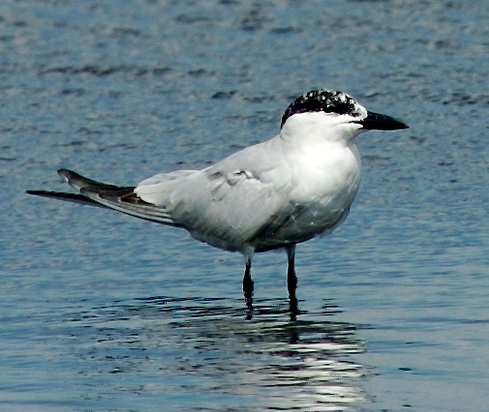
Gull-billed tern
Gelochelidon nilotica

Great black-backed gull
Larus marinus
Frequently asked questions
What does a Black-headed gull sound like?
You can hear 6 recordings of the Black-headed gull on this page, including its begging call, call and song. Birds produce sound with the syrinx, a vocal organ deep in the chest that can make two independent sounds at once.
Is the Black-headed gull endangered?
The IUCN Red List classifies the Black-headed gull as “least concern”.
What family does the Black-headed gull belong to?
The Black-headed gull (Chroicocephalus ridibundus) belongs to the family Laridae in the order Charadriiformes.
Sources & credits
- Black-headed Gulls (Larus ridibundus) (W1CDR0001402 BD19) – CC BY-SA 4.0 · Wikimedia Commons
- Begging call · Paris, Arrondissement de Paris, Île-de-France, France by Marie-Lan Taÿ Pamart – CC BY-SA 4.0 · Wikimedia Commons
- Call · Paris, Arrondissement de Paris, Île-de-France, France by Marie-Lan Taÿ Pamart – CC BY-SA 4.0 · Wikimedia Commons
- Begging call · Paris, Arrondissement de Paris, Île-de-France, France by Marie-Lan Taÿ Pamart – CC BY-SA 4.0 · Wikimedia Commons
- Song · Heriot-Watt University (near Currie), City of Edinburgh… by Dan Stowell – CC BY-SA 3.0 · Wikimedia Commons
- Call · Paris, Arrondissement de Paris, Île-de-France, France by Marie-Lan Taÿ Pamart – CC BY-SA 4.0 · Wikimedia Commons
- Wikidata Q25634 – CC0
- Wikipedia: Black-headed gull – CC BY-SA 4.0
- Photo by Diliff – CC BY-SA 3.0