Listen to the common moorhen
Tip: press play to see the sound's live frequency spectrum in blue over the waveform.
About the common moorhen
The common moorhen is a bird in the family Rallidae (order Gruiformes). Its conservation status on the IUCN Red List is “least concern”. Adults have a wingspan of about 52 cm and weigh around 348 g.
What does the common moorhen sound like?
Most birds have two kinds of vocalisation: songs, which are learned or innate phrases delivered mainly in spring and summer, and calls – brief contact, alarm and begging notes heard all year round. Listening for both helps with identification.
The recordings here are labelled as nocturnal flight call, flight call and call. Listen for differences in rhythm, pitch and repetition – the spectrum display makes it easy to see whether a sound is a pure whistle (a thin line), a harsh call (a broad band) or a trill (rapid repeated marks).
From Wikipedia
The common moorhen (Gallinula chloropus), also known as the waterhen, is a bird species in the rail family (Rallidae). It is distributed across many parts of the Old World, across Africa, Europe, and Asia. It lives around well-vegetated marshes, ponds, canals and other wetlands. The species is not found in the polar regions or many tropical rainforests; generally it is one of the most common Old World rail species, together with the Eurasian coot in some regions.
More from the family Rallidae

Eurasian coot
Fulica atra
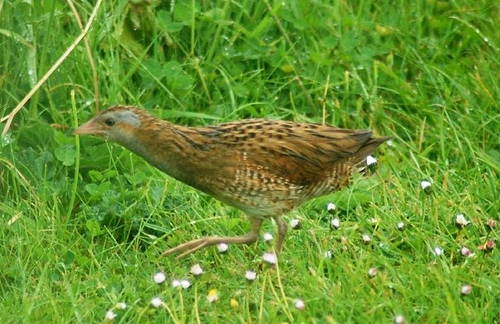
Corn crake
Crex crex

Water rail
Rallus aquaticus

Spotted crake
Porzana porzana

Baillon's crake
Zapornia pusilla

Western swamphen
Porphyrio porphyrio

White-breasted waterhen
Amaurornis phoenicurus
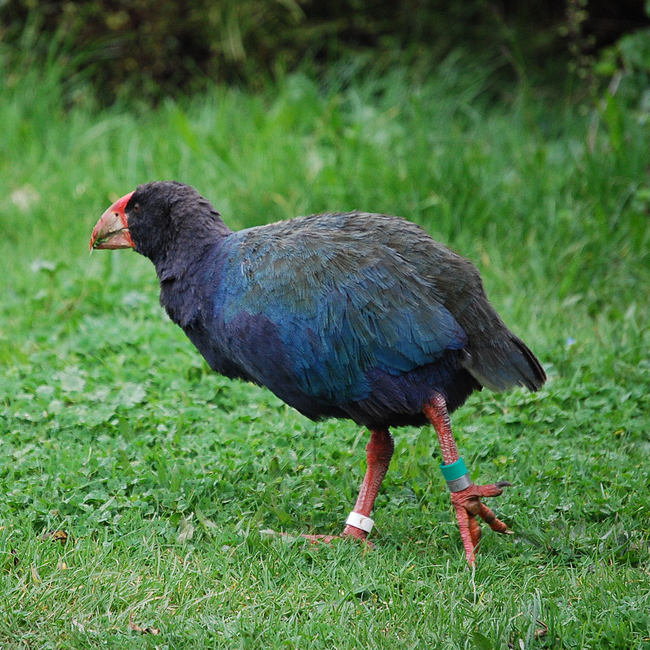
Takahē
Porphyrio hochstetteri

American coot
Fulica americana
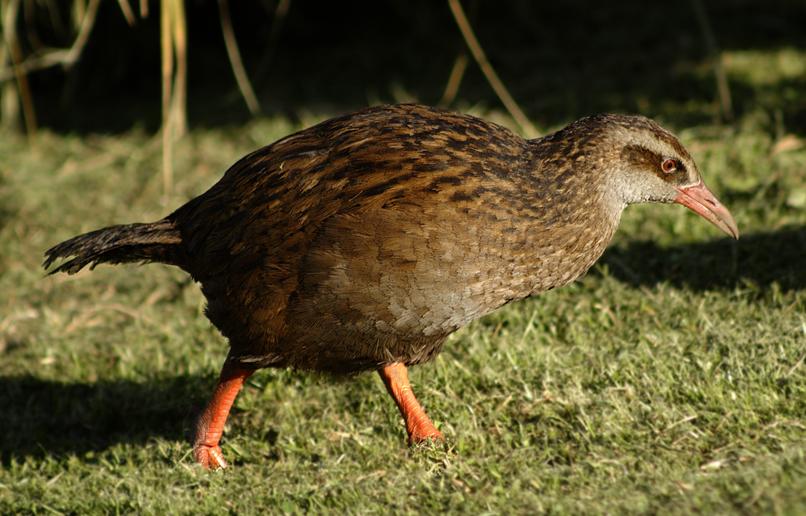
Weka
Gallirallus australis

Ruddy-breasted crake
Zapornia fusca

Red-knobbed coot
Fulica cristata
Frequently asked questions
What does a common moorhen sound like?
You can hear 6 recordings of the common moorhen on this page, including its nocturnal flight call, flight call and call. Most birds have two kinds of vocalisation: songs, which are learned or innate phrases delivered mainly in spring and summer, and calls – brief contact, alarm and begging notes heard all year round.
Is the common moorhen endangered?
The IUCN Red List classifies the common moorhen as “least concern”.
What family does the common moorhen belong to?
The common moorhen (Gallinula chloropus) belongs to the family Rallidae in the order Gruiformes.
Sources & credits
- Flight call, nocturnal flight call · Arnhem, Arnhem, Gelderland, Netherlands by Joost van Bruggen – CC BY-SA 4.0 · Wikimedia Commons
- Call · Greater Bilbao (near Getxo), Bizkaia, Euskadi, Spain by Borja – CC BY-SA 4.0 · Wikimedia Commons
- Nocturnal flight call · Fontaine-le-Comte, Vienne, Nouvelle-Aquitaine, France by Benoît Van Hecke – CC BY-SA 4.0 · Wikimedia Commons
- Flight call, nocturnal flight call · Latokaski, Espoo, Uusimaa, Finland by Mikko Heikkinen – CC BY-SA 4.0 · Wikimedia Commons
- Nocturnal flight call · Fontaine-le-Comte, Vienne, Nouvelle-Aquitaine, France by Benoît Van Hecke – CC BY-SA 4.0 · Wikimedia Commons
- Flight call · Arnhem, Arnhem, Gelderland, Netherlands by Joost van Bruggen – CC BY-SA 4.0 · Wikimedia Commons
- Wikidata Q18847 – CC0
- Wikipedia: Common moorhen – CC BY-SA 4.0
- Photo by gailhampshire from Cradley, Malvern, U.K – CC BY 2.0