Listen to the European robin
Tip: press play to see the sound's live frequency spectrum in blue over the waveform.
About the European robin
The European robin is a bird in the family Muscicapidae (order Passeriformes). Its conservation status on the IUCN Red List is “least concern”. Adults have a wingspan of about 21 cm and weigh around 2 g.
What does the European robin sound like?
Most birds have two kinds of vocalisation: songs, which are learned or innate phrases delivered mainly in spring and summer, and calls – brief contact, alarm and begging notes heard all year round. Listening for both helps with identification.
The recordings here are labelled as song, autumn song and call. Listen for differences in rhythm, pitch and repetition – the spectrum display makes it easy to see whether a sound is a pure whistle (a thin line), a harsh call (a broad band) or a trill (rapid repeated marks).
From Wikipedia
The European robin (Erithacus rubecula), known simply as the robin or robin redbreast in the British Isles, is a small insectivorous passerine bird belonging to the Old World flycatcher family Muscicapidae. It is found across Europe, as far east as Western Siberia, and as far south as North Africa. It is sedentary in the west and south of its range, and migratory in the north and east of its range where winters are harsher.
It is 12.5–14.0 cm (4.9–5.5 in) in length. The male and female are identical in plumage, with an orange-toned red breast and face lined with grey, brown upper-parts and a whitish belly. Juveniles are distinct, being freckled brown all over and lacking the red breast. First-winter immatures resemble the adults, except they have more obvious yellow-brown tips to the wing covert feathers, which are inconspicuous or absent in adults.
More from the family Muscicapidae

Common nightingale
Luscinia megarhynchos

Bluethroat
Luscinia svecica

Common redstart
Phoenicurus phoenicurus

Northern wheatear
Oenanthe oenanthe

Black redstart
Phoenicurus ochruros

Spotted flycatcher
Muscicapa striata

Blue rock thrush
Monticola solitarius

Red-breasted flycatcher
Ficedula parva

Thrush nightingale
Luscinia luscinia
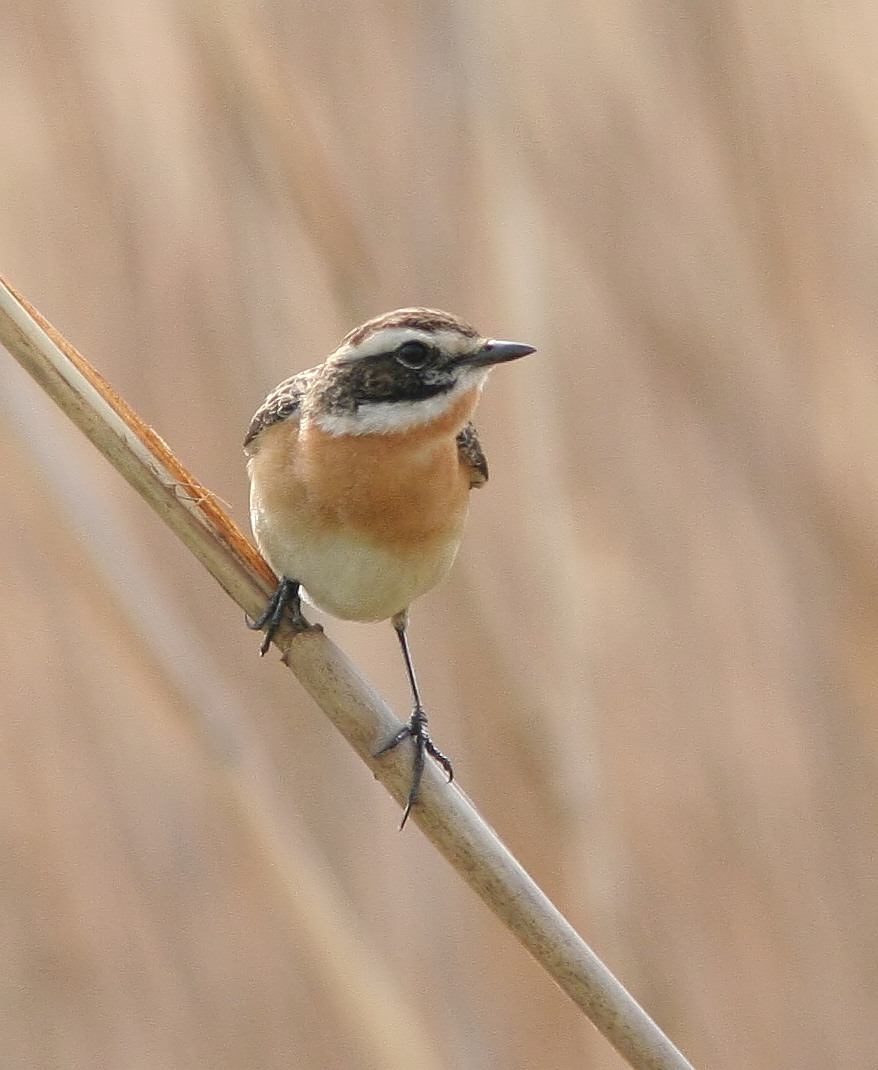
Whinchat
Saxicola rubetra

European pied flycatcher
Ficedula hypoleuca

Common rock thrush
Monticola saxatilis
Frequently asked questions
What does an European robin sound like?
You can hear 6 recordings of the European robin on this page, including its song, autumn song and call. Most birds have two kinds of vocalisation: songs, which are learned or innate phrases delivered mainly in spring and summer, and calls – brief contact, alarm and begging notes heard all year round.
Is the European robin endangered?
The IUCN Red List classifies the European robin as “least concern”.
What family does the European robin belong to?
The European robin (Erithacus rubecula) belongs to the family Muscicapidae in the order Passeriformes.
Sources & credits
- European Robin (Erithacus rubecula) (W1CDR0001425 BD16) – CC BY-SA 4.0 · Wikimedia Commons
- Autumn song, song · Botanical school, Jardin des Plantes, Paris… by Marie-Lan Taÿ Pamart – CC BY-SA 4.0 · Wikimedia Commons
- Song · Garden of the botanical school (near Paris)… by Marie-Lan Taÿ Pamart – CC BY-SA 4.0 · Wikimedia Commons
- Call, flight call, nocturnal flight call · Arnhem, Arnhem, Gelderland, Netherlands by Joost van Bruggen – CC BY-SA 4.0 · Wikimedia Commons
- Song · Fontaine-le-Comte, Vienne, Nouvelle-Aquitaine, France by Benoît Van Hecke – CC BY-SA 4.0 · Wikimedia Commons
- Call · Salzlandkreis (near Bernburg (Saale)), Sachsen-Anhalt… by Klaus-Jürgen Papke – CC BY-SA 4.0 · Wikimedia Commons
- Wikidata Q25334 – CC0
- Wikipedia: European robin – CC BY-SA 4.0
- Photo by Francis C. Franklin – CC BY-SA 3.0