Listen to the Fulvous antshrike
Tip: press play to see the sound's live frequency spectrum in blue over the waveform.
About the Fulvous antshrike
The Fulvous antshrike is a bird in the family Thamnophilidae (order Passeriformes).
What does the Fulvous antshrike sound like?
Bird vocalisations are usually divided into songs – longer, often complex phrases used to defend territory and attract mates, sung mostly by males in the breeding season – and calls: short, simple sounds for contact, alarm, begging or flight.
The recordings here are labelled as song. Listen for differences in rhythm, pitch and repetition – the spectrum display makes it easy to see whether a sound is a pure whistle (a thin line), a harsh call (a broad band) or a trill (rapid repeated marks).
From Wikipedia
The fulvous antshrike (Frederickena fulva) is a species of bird in subfamily Thamnophilinae of family Thamnophilidae, the "typical antbirds". It is found in Colombia, Ecuador, and Peru.
More from the family Thamnophilidae
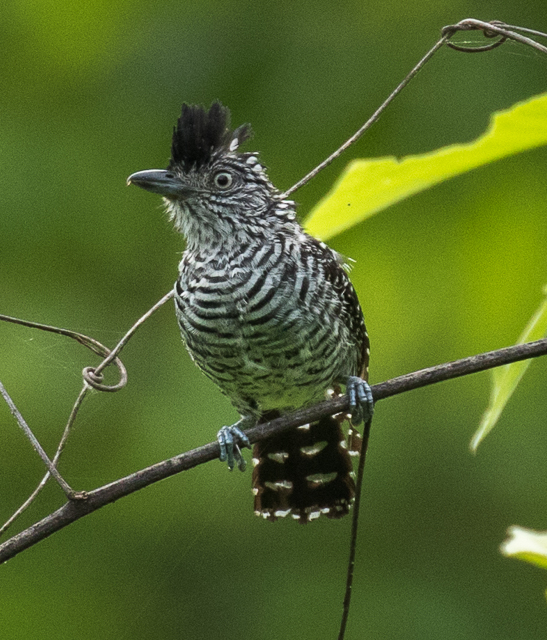
Barred antshrike
Thamnophilus doliatus

White-cheeked antbird
Gymnopithys leucaspis

Dusky antbird
Cercomacra tyrannina

Ocellated antbird
Phaenostictus mcleannani

Spotted antbird
Hylophylax naevioides

Long-winged antwren
Myrmotherula longipennis

Black-throated antbird
Myrmeciza atrothorax

Black-faced antbird
Myrmoborus myotherinus

Rufous-margined antwren
Herpsilochmus rufimarginatus

Banded antbird
Dichrozona cincta

Dot-backed antbird
Hylophylax punctulatus

Acre antshrike
Thamnophilus divisorius
Frequently asked questions
What does a Fulvous antshrike sound like?
You can hear 1 recording of the Fulvous antshrike on this page, including its song. Bird vocalisations are usually divided into songs – longer, often complex phrases used to defend territory and attract mates, sung mostly by males in the breeding season – and calls: short, simple sounds for contact, alarm, begging or flight.
What family does the Fulvous antshrike belong to?
The Fulvous antshrike (Frederickena fulva) belongs to the family Thamnophilidae in the order Passeriformes.
Sources & credits
- Song · Orellana: 'Maxus' road km 37 (27 km SSE Pompeya), Ecuador by Niels Krabbe – CC BY-SA 4.0 · Wikimedia Commons
- Wikidata Q1265503 – CC0
- Wikipedia: Fulvous antshrike – CC BY-SA 4.0
- Photo by Thibaud Aronson – CC BY-SA 4.0