Listen to the long-eared owl
Tip: press play to see the sound's live frequency spectrum in blue over the waveform.
About the long-eared owl
The long-eared owl is a bird in the family Strigidae (order Strigiformes). Its conservation status on the IUCN Red List is “least concern”. Adults have a wingspan of about 95 cm.
What does the long-eared owl sound like?
Bird vocalisations are usually divided into songs – longer, often complex phrases used to defend territory and attract mates, sung mostly by males in the breeding season – and calls: short, simple sounds for contact, alarm, begging or flight.
The recordings here are labelled as babbling, song, wingflap and begging call. Listen for differences in rhythm, pitch and repetition – the spectrum display makes it easy to see whether a sound is a pure whistle (a thin line), a harsh call (a broad band) or a trill (rapid repeated marks).
From Wikipedia
The long-eared owl (Asio otus), also known as the northern long-eared owl or informally as the lesser horned owl or cat owl, is a medium-sized typical owl with an extensive range. The genus name, Asio, is Latin for "horned owl", and the specific epithet, otus, is derived from Greek and refers to a small eared owl. It breeds in Europe and the Palearctic, as well as in North America.
More from the family Strigidae

Eurasian eagle-owl
Bubo bubo

Little owl
Athene noctua

Tawny owl
Strix aluco

Eurasian scops owl
Otus scops

Boreal owl
Aegolius funereus

Ural owl
Strix uralensis

Great horned owl
Bubo virginianus

Spotted owlet
Athene brama
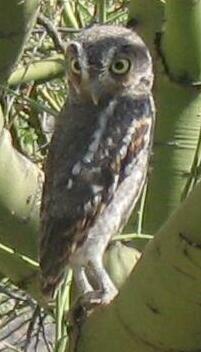
Elf owl
Micrathene whitneyi

Barred owl
Strix varia

Brown boobook
Ninox scutulata

Oriental scops owl
Otus sunia
Frequently asked questions
What does a long-eared owl sound like?
You can hear 6 recordings of the long-eared owl on this page, including its babbling, song and wingflap. Bird vocalisations are usually divided into songs – longer, often complex phrases used to defend territory and attract mates, sung mostly by males in the breeding season – and calls: short, simple sounds for contact, alarm, begging or flight.
Is the long-eared owl endangered?
The IUCN Red List classifies the long-eared owl as “least concern”.
What family does the long-eared owl belong to?
The long-eared owl (Asio otus) belongs to the family Strigidae in the order Strigiformes.
Sources & credits
- Babbling · Marans, Charente-Maritime, Nouvelle-Aquitaine, France by JACOB Hervé – CC BY-SA 4.0 · Wikimedia Commons
- Babbling · Marans, Charente-Maritime, Nouvelle-Aquitaine, France by JACOB Hervé – CC BY-SA 4.0 · Wikimedia Commons
- Babbling · Marans, Charente-Maritime, Nouvelle-Aquitaine, France by JACOB Hervé – CC BY-SA 4.0 · Wikimedia Commons
- Song, wingflap · Pod grúne - Volovec, Slovakia by Alexander Kurthy – CC BY-SA 4.0 · Wikimedia Commons
- Asio otus - Long-eared Owl by Vidar – CC BY-SA 4.0 · Wikimedia Commons
- Begging call · Neu-Ulm (near Senden), Schwaben, Bayern, Germany by Benjamin Mayer – CC BY-SA 4.0 · Wikimedia Commons
- Wikidata Q25384 – CC0
- Wikipedia: Long-eared owl – CC BY-SA 4.0
- Photo by Mykola Swarnyk – CC BY-SA 3.0