Listen to the Red-cheeked cordon-bleu
Tip: press play to see the sound's live frequency spectrum in blue over the waveform.
About the Red-cheeked cordon-bleu
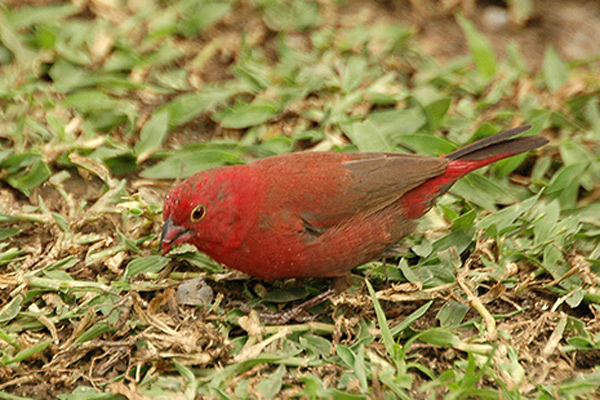
The Red-cheeked cordon-bleu is a bird in the family Estrildidae (order Passeriformes). Its conservation status on the IUCN Red List is “least concern”. Adults weigh around 10 g.
What does the Red-cheeked cordon-bleu sound like?
Birds produce sound with the syrinx, a vocal organ deep in the chest that can make two independent sounds at once. Songs tend to be long and patterned and are used to hold territory and attract a mate; calls are short signals for contact, alarm and flight.
The recordings here are labelled as song. Listen for differences in rhythm, pitch and repetition – the spectrum display makes it easy to see whether a sound is a pure whistle (a thin line), a harsh call (a broad band) or a trill (rapid repeated marks).
From Wikipedia
The red-cheeked cordon-bleu or red-cheeked cordonbleu (Uraeginthus bengalus) is a small passerine bird in the family Estrildidae. This estrildid finch is a resident breeding bird in drier regions of tropical Sub-Saharan Africa. Red-cheeked cordon-bleu has an estimated global extent of occurrence of 7,700,000 km2.
Related birds in the genus Uraeginthus

More from the family Estrildidae



Frequently asked questions
What does a Red-cheeked cordon-bleu sound like?
You can hear 1 recording of the Red-cheeked cordon-bleu on this page, including its song. Birds produce sound with the syrinx, a vocal organ deep in the chest that can make two independent sounds at once.
Is the Red-cheeked cordon-bleu endangered?
The IUCN Red List classifies the Red-cheeked cordon-bleu as “least concern”.
What family does the Red-cheeked cordon-bleu belong to?
The Red-cheeked cordon-bleu (Uraeginthus bengalus) belongs to the family Estrildidae in the order Passeriformes.
Sources & credits
- Song · Nairobi, Nairobi County, Kenya by Anne Ndung'u – CC BY-SA 4.0 · Wikimedia Commons
- Wikidata Q1070293 – CC0
- Wikipedia: Red-cheeked cordon-bleu – CC BY-SA 4.0
- Photo by gisela gerson lohman-braun – CC BY-SA 2.0