Listen to the Rondônia bushbird
Tip: press play to see the sound's live frequency spectrum in blue over the waveform.
About the Rondônia bushbird
The Rondônia bushbird is a bird in the family Thamnophilidae (order Passeriformes). Its conservation status on the IUCN Red List is “near threatened”.
What does the Rondônia bushbird sound like?
Birds produce sound with the syrinx, a vocal organ deep in the chest that can make two independent sounds at once. Songs tend to be long and patterned and are used to hold territory and attract a mate; calls are short signals for contact, alarm and flight.
From Wikipedia
The Rondonia bushbird (Clytoctantes atrogularis) is a Near Threatened species of bird in subfamily Thamnophilinae of family Thamnophilidae, the "typical antbirds". It is endemic to Brazil.
More from the family Thamnophilidae
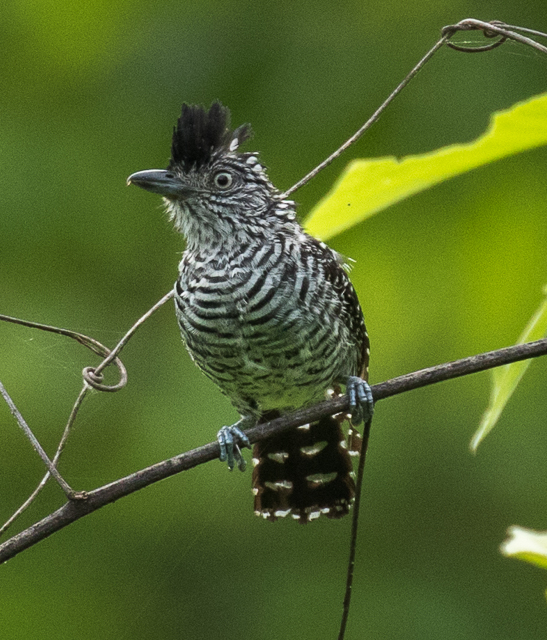
Barred antshrike
Thamnophilus doliatus

White-cheeked antbird
Gymnopithys leucaspis

Dusky antbird
Cercomacra tyrannina

Ocellated antbird
Phaenostictus mcleannani

Spotted antbird
Hylophylax naevioides

Long-winged antwren
Myrmotherula longipennis

Black-throated antbird
Myrmeciza atrothorax

Black-faced antbird
Myrmoborus myotherinus

Rufous-margined antwren
Herpsilochmus rufimarginatus

Banded antbird
Dichrozona cincta

Dot-backed antbird
Hylophylax punctulatus

Acre antshrike
Thamnophilus divisorius
Frequently asked questions
What does a Rondônia bushbird sound like?
You can hear 1 recording of the Rondônia bushbird on this page. Birds produce sound with the syrinx, a vocal organ deep in the chest that can make two independent sounds at once.
Is the Rondônia bushbird endangered?
The IUCN Red List classifies the Rondônia bushbird as “near threatened”.
What family does the Rondônia bushbird belong to?
The Rondônia bushbird (Clytoctantes atrogularis) belongs to the family Thamnophilidae in the order Passeriformes.
Sources & credits
- Clytoctantes atrogularis - Rondonia Bushbird by Marco Cruz – CC BY-SA 4.0 · Wikimedia Commons
- Wikidata Q1263952 – CC0
- Wikipedia: Rondônia bushbird – CC BY-SA 4.0
- Photo by Hector Bottai – CC BY-SA 4.0