Listen to the southern masked weaver
Tip: press play to see the sound's live frequency spectrum in blue over the waveform.
About the southern masked weaver
The southern masked weaver is a bird in the family Ploceidae (order Passeriformes). Its conservation status on the IUCN Red List is “least concern”.
What does the southern masked weaver sound like?
Most birds have two kinds of vocalisation: songs, which are learned or innate phrases delivered mainly in spring and summer, and calls – brief contact, alarm and begging notes heard all year round. Listening for both helps with identification.
From Wikipedia
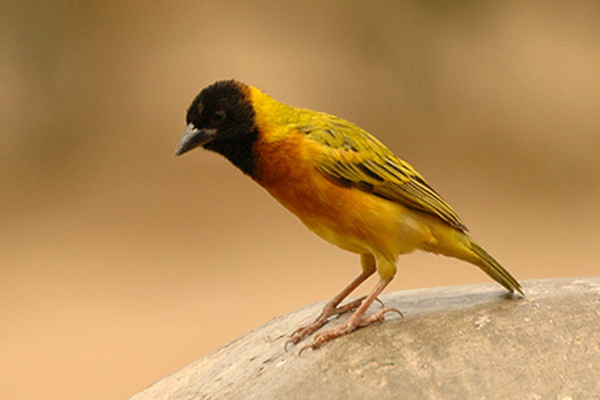
The southern masked weaver (Ploceus velatus), or African masked weaver, is a resident breeding bird species common throughout southern Africa.
This weaver is very widespread and found in a wide range of habitats, including shrubland, savanna, grassland, open woodland, inland wetlands and semi-desert areas. It also occurs in sub-urban gardens and parks.
Related birds in the genus Ploceus

More from the family Ploceidae


Frequently asked questions
What does a southern masked weaver sound like?
You can hear 1 recording of the southern masked weaver on this page. Most birds have two kinds of vocalisation: songs, which are learned or innate phrases delivered mainly in spring and summer, and calls – brief contact, alarm and begging notes heard all year round.
Is the southern masked weaver endangered?
The IUCN Red List classifies the southern masked weaver as “least concern”.
What family does the southern masked weaver belong to?
The southern masked weaver (Ploceus velatus) belongs to the family Ploceidae in the order Passeriformes.
Sources & credits
- Ploceus velatus velatus, wintersang, Pta NBT, 2022-07-23 15h52, a by JMK – CC BY-SA 4.0 · Wikimedia Commons
- Wikidata Q787215 – CC0
- Wikipedia: Southern masked weaver – CC BY-SA 4.0
- Photo by Charles J. Sharp – CC BY-SA 4.0