Listen to the Willow flycatcher
Tip: press play to see the sound's live frequency spectrum in blue over the waveform.
About the Willow flycatcher
The Willow flycatcher is a bird in the family Tyrannidae (order Passeriformes). Its conservation status on the IUCN Red List is “least concern”. Adults weigh around 13 g.
What does the Willow flycatcher sound like?
Birds produce sound with the syrinx, a vocal organ deep in the chest that can make two independent sounds at once. Songs tend to be long and patterned and are used to hold territory and attract a mate; calls are short signals for contact, alarm and flight.
The recordings here are labelled as empidonax traillii. Listen for differences in rhythm, pitch and repetition – the spectrum display makes it easy to see whether a sound is a pure whistle (a thin line), a harsh call (a broad band) or a trill (rapid repeated marks).
From Wikipedia
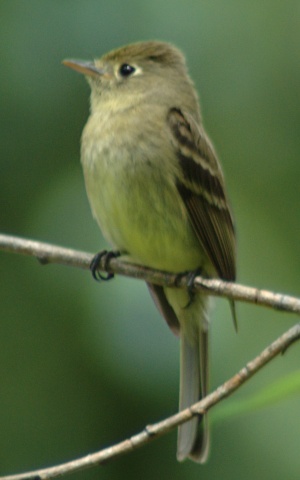
The willow flycatcher (Empidonax traillii) is a small insect-eating, migrant bird of the tyrant flycatcher family native to North America.
Related birds in the genus Empidonax


More from the family Tyrannidae

Great kiskadee
Pitangus sulphuratus

Eastern kingbird
Tyrannus tyrannus

Eastern phoebe
Sayornis phoebe

Cliff flycatcher
Hirundinea ferruginea

Yellow-crowned tyrannulet
Tyrannulus elatus

Olive-sided flycatcher
Contopus cooperi

Yellow tyrannulet
Capsiempis flaveola

Masked water tyrant
Fluvicola nengeta
Frequently asked questions
What does a Willow flycatcher sound like?
You can hear 1 recording of the Willow flycatcher on this page, including its empidonax traillii. Birds produce sound with the syrinx, a vocal organ deep in the chest that can make two independent sounds at once.
Is the Willow flycatcher endangered?
The IUCN Red List classifies the Willow flycatcher as “least concern”.
What family does the Willow flycatcher belong to?
The Willow flycatcher (Empidonax traillii) belongs to the family Tyrannidae in the order Passeriformes.
Sources & credits
- Empidonax traillii – Public domain · Wikimedia Commons
- Wikidata Q903847 – CC0
- Wikipedia: Willow flycatcher – CC BY-SA 4.0
- Photo by Paul Danese – CC BY-SA 4.0