Listen to the common poorwill
Tip: press play to see the sound's live frequency spectrum in blue over the waveform.
About the common poorwill
The common poorwill is a bird in the family Caprimulgidae (order Caprimulgiformes). Its conservation status on the IUCN Red List is “least concern”. Adults weigh around 48 g.
What does the common poorwill sound like?
Most birds have two kinds of vocalisation: songs, which are learned or innate phrases delivered mainly in spring and summer, and calls – brief contact, alarm and begging notes heard all year round. Listening for both helps with identification.
The recordings here are labelled as song. Listen for differences in rhythm, pitch and repetition – the spectrum display makes it easy to see whether a sound is a pure whistle (a thin line), a harsh call (a broad band) or a trill (rapid repeated marks).
From Wikipedia
The common poorwill (Phalaenoptilus nuttallii) is a nocturnal bird of the family Caprimulgidae, the nightjars. It is found from British Columbia and southeastern Alberta, through the western United States to northern Mexico. The bird's habitat is dry, open areas with grasses or shrubs, and even stony desert slopes with very little vegetation.
Many northern birds migrate to winter within the breeding range in central and western Mexico, though some remain further north. The common poorwill is the only bird known to go into torpor for extended periods (weeks to months). This happens on the southern edge of its range in the United States, where it spends much of the winter inactive, concealed in piles of rocks. Such an extended period of torpor is close to a state of hibernation and is not known among other birds.
More from the family Caprimulgidae

European nightjar
Caprimulgus europaeus

Common nighthawk
Chordeiles minor

Indian nightjar
Caprimulgus asiaticus

Jungle nightjar
Caprimulgus indicus

Savanna nightjar
Caprimulgus affinis

Jerdon's nightjar
Caprimulgus atripennis

Pauraque
Nyctidromus albicollis

Eastern whip-poor-will
Antrostomus vociferus
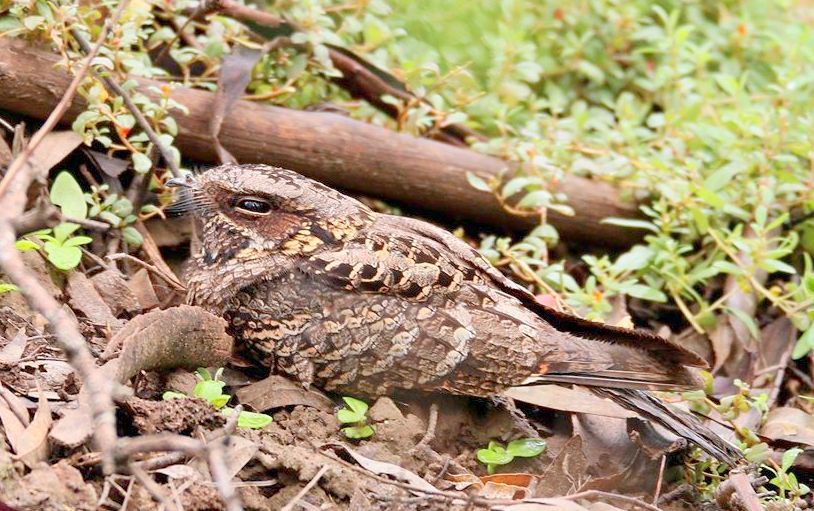
Fiery-necked nightjar
Caprimulgus pectoralis

Brown nightjar
Veles binotatus
Frequently asked questions
What does a common poorwill sound like?
You can hear 3 recordings of the common poorwill on this page, including its song. Most birds have two kinds of vocalisation: songs, which are learned or innate phrases delivered mainly in spring and summer, and calls – brief contact, alarm and begging notes heard all year round.
Is the common poorwill endangered?
The IUCN Red List classifies the common poorwill as “least concern”.
What family does the common poorwill belong to?
The common poorwill (Phalaenoptilus nuttallii) belongs to the family Caprimulgidae in the order Caprimulgiformes.
Sources & credits
- Common Poorwill Great Basin National Park by National Park Service – Public domain · Wikimedia Commons
- Song · Blue Bell Campground, Custer State Park, South Dakota… by Jonathon Jongsma – CC BY-SA 4.0 · Wikimedia Commons
- Common Poorwill – US National Park Service by NPS – Public domain (NPS) · NPS
- Wikidata Q930457 – CC0
- Wikipedia: Common poorwill – CC BY-SA 4.0
- Photo by Louis Agassiz Fuertes (artist, 1874-1927) – Public domain