Listen to the European nightjar
Tip: press play to see the sound's live frequency spectrum in blue over the waveform.
About the European nightjar
The European nightjar is a bird in the family Caprimulgidae (order Caprimulgiformes). Its conservation status on the IUCN Red List is “least concern”. Adults have a wingspan of about 60 cm.
What does the European nightjar sound like?
Birds produce sound with the syrinx, a vocal organ deep in the chest that can make two independent sounds at once. Songs tend to be long and patterned and are used to hold territory and attract a mate; calls are short signals for contact, alarm and flight.
The recordings here are labelled as song, flight call and wingbeats. Listen for differences in rhythm, pitch and repetition – the spectrum display makes it easy to see whether a sound is a pure whistle (a thin line), a harsh call (a broad band) or a trill (rapid repeated marks).
From Wikipedia
The European nightjar (Caprimulgus europaeus), common goatsucker, Eurasian nightjar or just nightjar is a crepuscular and nocturnal bird in the nightjar family that breeds across most of Europe and the Palearctic to Mongolia and Northwestern China. The Latin generic name refers to the old myth that the nocturnal nightjar suckled from goats, causing them to cease to give milk. The six subspecies differ clinally, the birds becoming smaller and paler towards the east of the range. All populations are migratory, wintering in sub-Saharan Africa. Their densely patterned grey and brown plumage makes individuals difficult to see in the daytime when they rest on the ground or perch motionless along a branch, although the male shows white patches in the wings and tail as he flies at night.
Related birds in the genus Caprimulgus


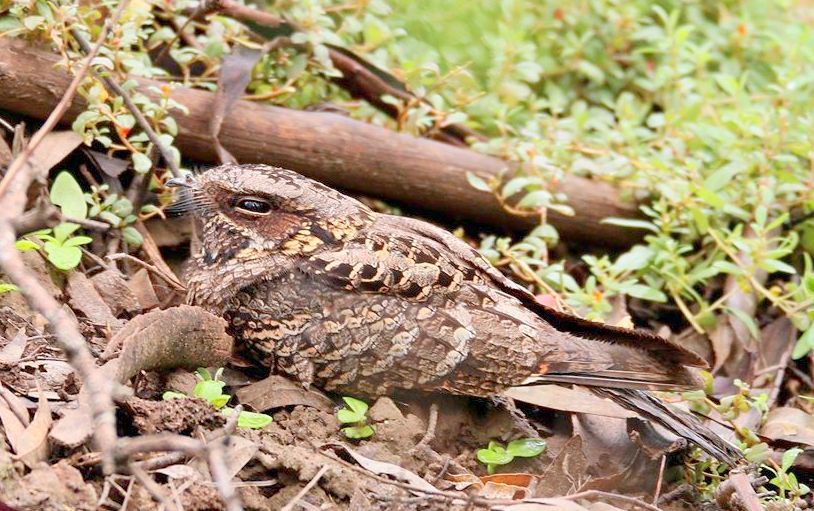
More from the family Caprimulgidae
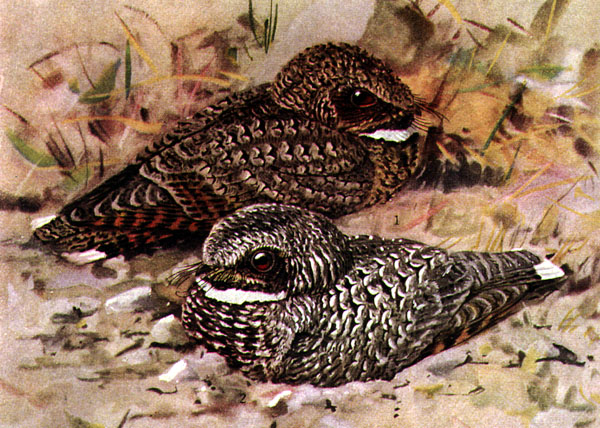


Frequently asked questions
What does an European nightjar sound like?
You can hear 6 recordings of the European nightjar on this page, including its song, flight call and wingbeats. Birds produce sound with the syrinx, a vocal organ deep in the chest that can make two independent sounds at once.
Is the European nightjar endangered?
The IUCN Red List classifies the European nightjar as “least concern”.
What family does the European nightjar belong to?
The European nightjar (Caprimulgus europaeus) belongs to the family Caprimulgidae in the order Caprimulgiformes.
Sources & credits
- European Nightjar (Caprimulgus europaeus) (W1CDR0001526 BD23) – CC BY-SA 4.0 · Wikimedia Commons
- Flight call, song · Fontaine-le-Comte, Vienne, Nouvelle-Aquitaine, France by Benoît Van Hecke – CC BY-SA 4.0 · Wikimedia Commons
- Song · Fontaine-le-Comte, Vienne, Nouvelle-Aquitaine, France by Benoît Van Hecke – CC BY-SA 4.0 · Wikimedia Commons
- Song · Schneverdingen, Germany by ChristianSW – CC0 1.0 · Wikimedia Commons
- Wingbeats · Rozendaal, Rozendaal, Gelderland, Netherlands by Joost van Bruggen – CC BY-SA 4.0 · Wikimedia Commons
- Call, flight call, migration flightcall, nocturnal flightcall · Arnhem, Arnhem, Gelderland, Netherlands by Joost van Bruggen – CC BY-SA 4.0 · Wikimedia Commons
- Wikidata Q26717 – CC0
- Wikipedia: European nightjar – CC BY-SA 4.0
- Photo by P.Taszynski – CC BY-SA 3.0