Listen to the edible frog
Tip: press play to see the sound's live frequency spectrum in blue over the waveform.
About the edible frog
The edible frog is a amphibian in the family Ranidae (order Anura).
What does the edible frog sound like?
Frog and toad calls are produced by males, who inflate a vocal sac to amplify the sound. Choruses are loudest on warm, humid nights in the breeding season, and each species' call has its own pitch, rhythm and pulse rate.
The recordings here are labelled as maulwurfsgrille audio cf. Listen for differences in rhythm, pitch and repetition – the spectrum display makes it easy to see whether a sound is a pure whistle (a thin line), a harsh call (a broad band) or a trill (rapid repeated marks).
From Wikipedia
The edible frog (Pelophylax kl. esculentus) is a hybrid species of common European frog, also known as the common water frog or green frog (however, this latter term is also used for the North American species Rana clamitans).
It is used for food, particularly in France as well as Germany and Italy, for the delicacy frog legs. Females are between 5 and 9 cm (2.0 and 3.5 in) long, males between 6 and 11 cm (2.4 and 4.3 in).
Related frogs & amphibians in the genus Pelophylax


More from the family Ranidae


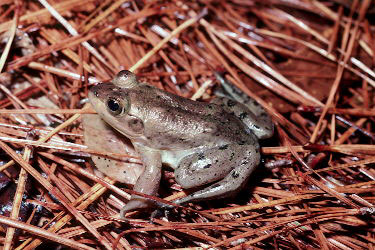
Frequently asked questions
What does an edible frog sound like?
You can hear 2 recordings of the edible frog on this page, including its maulwurfsgrille audio cf. Frog and toad calls are produced by males, who inflate a vocal sac to amplify the sound.
What family does the edible frog belong to?
The edible frog (Pelophylax esculentus) belongs to the family Ranidae in the order Anura.
Sources & credits
- 20 bastaardkikker enkele individuen Rana kl. esculenta some individuals by Odé, Baudewijn .mw-parser-output .messagebox{margin:4px 0;width:auto;border-collapse:collapse;border:2px solid… – CC BY-SA 4.0 · Wikimedia Commons
- Maulwurfsgrille Audio CF by Christian Fischer – CC BY-SA 4.0 · Wikimedia Commons
- Wikidata Q31694 – CC0
- Wikipedia: Edible frog – CC BY-SA 4.0
- Photo by Björn S. – CC BY-SA 3.0