Listen to the Pool frog
Tip: press play to see the sound's live frequency spectrum in blue over the waveform.
About the Pool frog
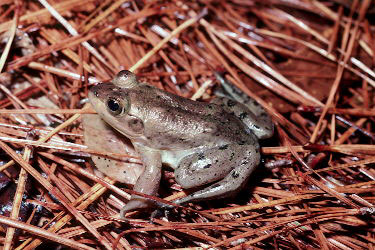
The Pool frog is a amphibian in the family Ranidae (order Anura). Its conservation status on the IUCN Red List is “least concern”.
What does the Pool frog sound like?
Male frogs and toads call by pushing air over their vocal cords into a vocal sac that acts as a resonator. Each species has its own call, so choruses can be identified by ear – and calling peaks on warm, wet nights.
From Wikipedia
The pool frog (Pelophylax lessonae) is a species of frog in the family Ranidae. It is found in and around shallow, stagnant bodies of water across much of Europe, from France in the west to Russia in the east. Active in such areas from March to October, it disperses from the water to hibernate in woodland soil during the winter, and can tolerate being frozen overnight while hibernating. A close relative of the marsh frog, the two species can interbreed to produce a hybrid called the edible frog, which maintains its own population by breeding with one of its parental species. The pool frog is very similar in appearance to these related species, but can be distinguished based on vocal sac color, snout shape, leg length, the shape of a hardened lump on the foot, and skeletal features.
Related frogs & amphibians in the genus Pelophylax


More from the family Ranidae


Frequently asked questions
What does a Pool frog sound like?
You can hear 1 recording of the Pool frog on this page. Male frogs and toads call by pushing air over their vocal cords into a vocal sac that acts as a resonator.
Is the Pool frog endangered?
The IUCN Red List classifies the Pool frog as “least concern”.
What family does the Pool frog belong to?
The Pool frog (Pelophylax lessonae) belongs to the family Ranidae in the order Anura.
Sources & credits
- Tiigikonn juuni 2026 by Sillerkiil – CC BY-SA 1.0 · Wikimedia Commons
- Wikidata Q754058 – CC0
- Wikipedia: Pool frog – CC BY-SA 4.0
- Photo by Christian Fischer – CC BY-SA 3.0