Listen to the Eurasian bittern
Tip: press play to see the sound's live frequency spectrum in blue over the waveform.
About the Eurasian bittern
The Eurasian bittern is a bird in the family Ardeidae (order Pelecaniformes). Its conservation status on the IUCN Red List is “least concern”. Adults have a wingspan of about 127 cm and weigh around 2.0 kg.
What does the Eurasian bittern sound like?
Bird vocalisations are usually divided into songs – longer, often complex phrases used to defend territory and attract mates, sung mostly by males in the breeding season – and calls: short, simple sounds for contact, alarm, begging or flight.
The recordings here are labelled as flight call, song and nocturnal flight call. Listen for differences in rhythm, pitch and repetition – the spectrum display makes it easy to see whether a sound is a pure whistle (a thin line), a harsh call (a broad band) or a trill (rapid repeated marks).
From Wikipedia
The Eurasian bittern or great bittern (Botaurus stellaris) is a wading bird in the bittern subfamily (Botaurinae) of the heron family Ardeidae. There are two subspecies, the northern race (B. s. stellaris) breeding in parts of Europe and across the Palearctic, as well as on the northern coast of Africa, while the southern race (B. s. capensis) is endemic to parts of southern Africa. It is a secretive bird, seldom seen in the open as it prefers to skulk in reed beds and thick vegetation near water bodies. Its presence is apparent in the spring, when the booming call of the male during the breeding season can be heard. It feeds on fish, small mammals, fledgling birds, amphibians, crustaceans and insects.
The nest is usually built among reeds at the edge of bodies of water. The female incubates the clutch of eggs and feeds the young chicks, which leave the nest when about two weeks old. She continues to care for them until they are fully fledged some six weeks later.
Related birds in the genus Botaurus


More from the family Ardeidae

Grey heron
Ardea cinerea

Great egret
Ardea alba

Black-crowned night heron
Nycticorax nycticorax

Little egret
Egretta garzetta

Purple heron
Ardea purpurea
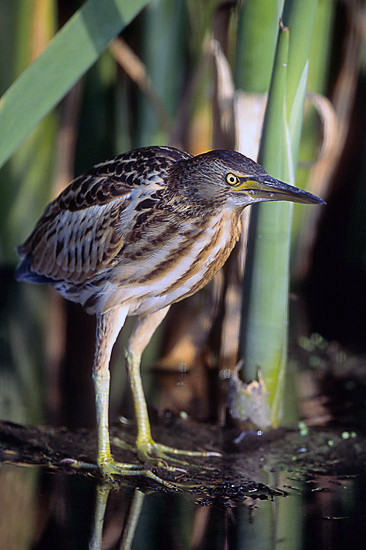
Little bittern
Botaurus minutus

Striated heron
Butorides striata

Indian pond heron
Ardeola grayii

Agami heron
Agamia agami

Black-headed heron
Ardea melanocephala
Frequently asked questions
What does an Eurasian bittern sound like?
You can hear 5 recordings of the Eurasian bittern on this page, including its flight call, song and nocturnal flight call. Bird vocalisations are usually divided into songs – longer, often complex phrases used to defend territory and attract mates, sung mostly by males in the breeding season – and calls: short, simple sounds for contact, alarm, begging or flight.
Is the Eurasian bittern endangered?
The IUCN Red List classifies the Eurasian bittern as “least concern”.
What family does the Eurasian bittern belong to?
The Eurasian bittern (Botaurus stellaris) belongs to the family Ardeidae in the order Pelecaniformes.
Sources & credits
- Eurasian Bittern (Botaurus stellaris) (W BOTAURUS STELLARIS R1 C1) – CC BY-SA 4.0 · Wikimedia Commons
- Flight call · Arnhem, Arnhem, Gelderland, Netherlands by Joost van Bruggen – CC BY-SA 4.0 · Wikimedia Commons
- Flight call · Arnhem, Arnhem, Gelderland, Netherlands by Joost van Bruggen – CC BY-SA 4.0 · Wikimedia Commons
- Song · Svätá Mária, Trebišov District, Košice Region, Slovakia by Miro Demko – CC BY-SA 3.0 · Wikimedia Commons
- Nocturnal flight call · Dresden, Dresden, Sachsen, Germany by Jens Loose – CC BY-SA 4.0 · Wikimedia Commons
- Wikidata Q25709 – CC0
- Wikipedia: Eurasian bittern – CC BY-SA 4.0
- Photo by Francesco Veronesi from Italy – CC BY-SA 2.0