Listen to the purple heron
Tip: press play to see the sound's live frequency spectrum in blue over the waveform.
About the purple heron
The purple heron is a bird in the family Ardeidae (order Pelecaniformes). Its conservation status on the IUCN Red List is “least concern”. Adults have a wingspan of about 135 cm and weigh around 51 g.
What does the purple heron sound like?
Most birds have two kinds of vocalisation: songs, which are learned or innate phrases delivered mainly in spring and summer, and calls – brief contact, alarm and begging notes heard all year round. Listening for both helps with identification.
The recordings here are labelled as alarm call and flight call. Listen for differences in rhythm, pitch and repetition – the spectrum display makes it easy to see whether a sound is a pure whistle (a thin line), a harsh call (a broad band) or a trill (rapid repeated marks).
From Wikipedia
The purple heron (Ardea purpurea) is a wide-ranging heron species. It breeds in Africa, central and southern Europe, and southern and eastern Palearctic. The Western Palearctic populations migrate between breeding and wintering habitats whereas the African and tropical-Asian populations are primarily sedentary, except for occasional dispersive movements.
It is similar in appearance to the more common grey heron but is slightly smaller, more slender and has darker plumage. It is also a more evasive bird, favouring densely vegetated habitats near water, particularly reed beds. It hunts for a range of prey including fish, rodents, frogs and insects, either stalking them or standing waiting in ambush.
Related birds in the genus Ardea


More from the family Ardeidae

Black-crowned night heron
Nycticorax nycticorax
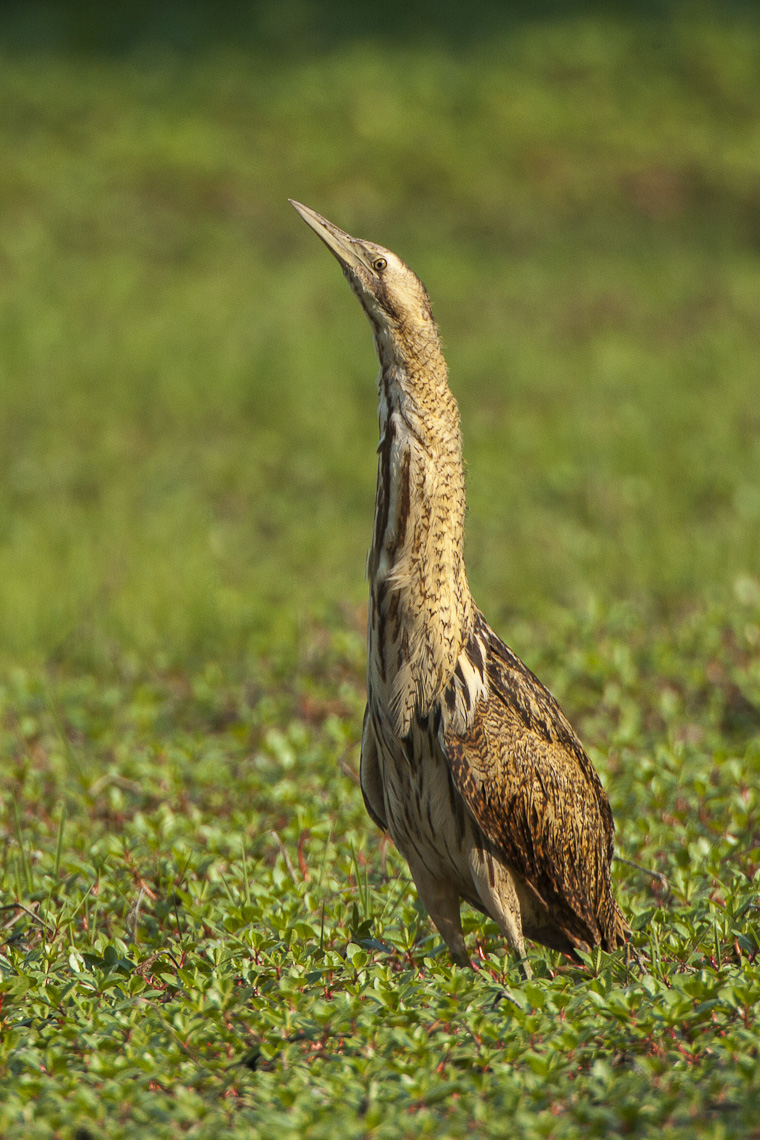
Eurasian bittern
Botaurus stellaris

Little egret
Egretta garzetta
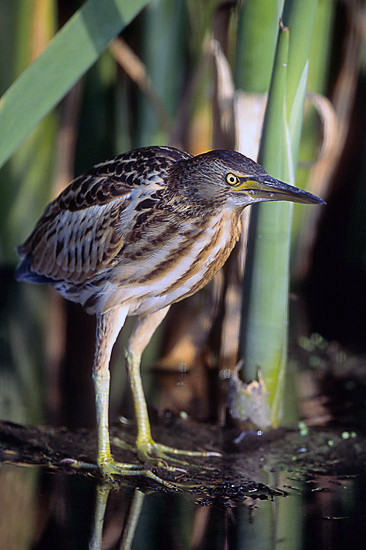
Little bittern
Botaurus minutus

Striated heron
Butorides striata

Indian pond heron
Ardeola grayii

Agami heron
Agamia agami

American bittern
Botaurus lentiginosus

Green heron
Butorides virescens
Frequently asked questions
What does a purple heron sound like?
You can hear 3 recordings of the purple heron on this page, including its alarm call and flight call. Most birds have two kinds of vocalisation: songs, which are learned or innate phrases delivered mainly in spring and summer, and calls – brief contact, alarm and begging notes heard all year round.
Is the purple heron endangered?
The IUCN Red List classifies the purple heron as “least concern”.
What family does the purple heron belong to?
The purple heron (Ardea purpurea) belongs to the family Ardeidae in the order Pelecaniformes.
Sources & credits
- Alarm call · Mangalajodi, Khordha, Odisha by Sudipto Roy – CC BY-SA 3.0 · Wikimedia Commons
- Flight call · Área Metropolitana de Sevilla (near Isla Mayor), Sevilla… by Joost van Bruggen – CC BY-SA 4.0 · Wikimedia Commons
- Purple heron 01 by Ganesh Mohan T – CC BY-SA 4.0 · Wikimedia Commons
- Wikidata Q160488 – CC0
- Wikipedia: Purple heron – CC BY-SA 4.0
- Photo by Yathin S Krishnappa – CC BY-SA 3.0