Listen to the European green woodpecker
Tip: press play to see the sound's live frequency spectrum in blue over the waveform.
About the European green woodpecker
The European green woodpecker is a bird in the family Picidae (order Piciformes). Its conservation status on the IUCN Red List is “least concern”. Adults have a wingspan of about 41 cm and weigh around 193 g.
What does the European green woodpecker sound like?
Most birds have two kinds of vocalisation: songs, which are learned or innate phrases delivered mainly in spring and summer, and calls – brief contact, alarm and begging notes heard all year round. Listening for both helps with identification.
The recordings here are labelled as alarm call, song and drumming. Listen for differences in rhythm, pitch and repetition – the spectrum display makes it easy to see whether a sound is a pure whistle (a thin line), a harsh call (a broad band) or a trill (rapid repeated marks).
From Wikipedia
The European green woodpecker (Picus viridis), also known as the yaffle and sometimes called a nickle, is a large green woodpecker with a bright red crown and a black moustache. Males have a red centre to the moustache stripe which is absent in females. It is resident across much of Europe and the western Palearctic but in Spain and Portugal it is replaced by the similar Iberian green woodpecker (Picus sharpei).
The European green woodpecker spends much of its time feeding on ants on the ground and does not often 'drum' on trees like other woodpecker species. Though its vivid green and red plumage is particularly striking, it is a shy bird, and is more often heard than seen, drawing attention with its loud calls. A nest hole is excavated in a tree; four to six eggs are laid which hatch after 19–20 days.
Related birds in the genus Picus

More from the family Picidae

Great spotted woodpecker
Dendrocopos major

Black woodpecker
Dryocopus martius

Eurasian wryneck
Jynx torquilla

Lesser spotted woodpecker
Dryobates minor

Eurasian three-toed woodpecker
Picoides tridactylus
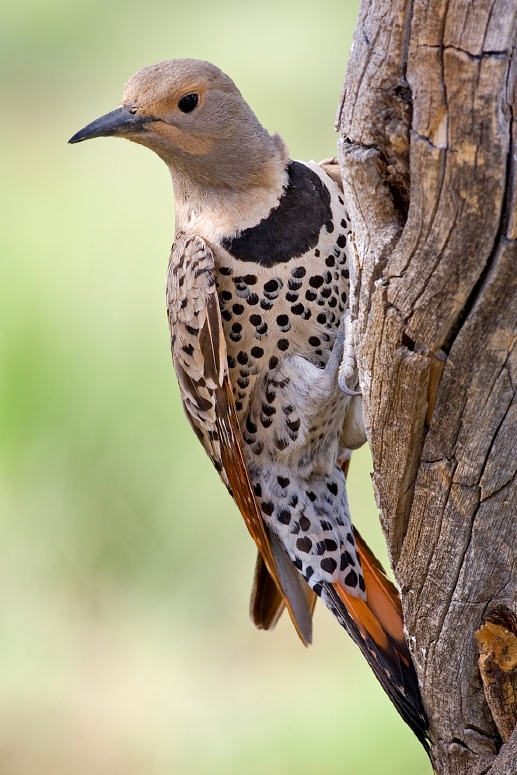
Northern flicker
Colaptes auratus

Pileated woodpecker
Dryocopus pileatus

Black-rumped flameback
Dinopium benghalense
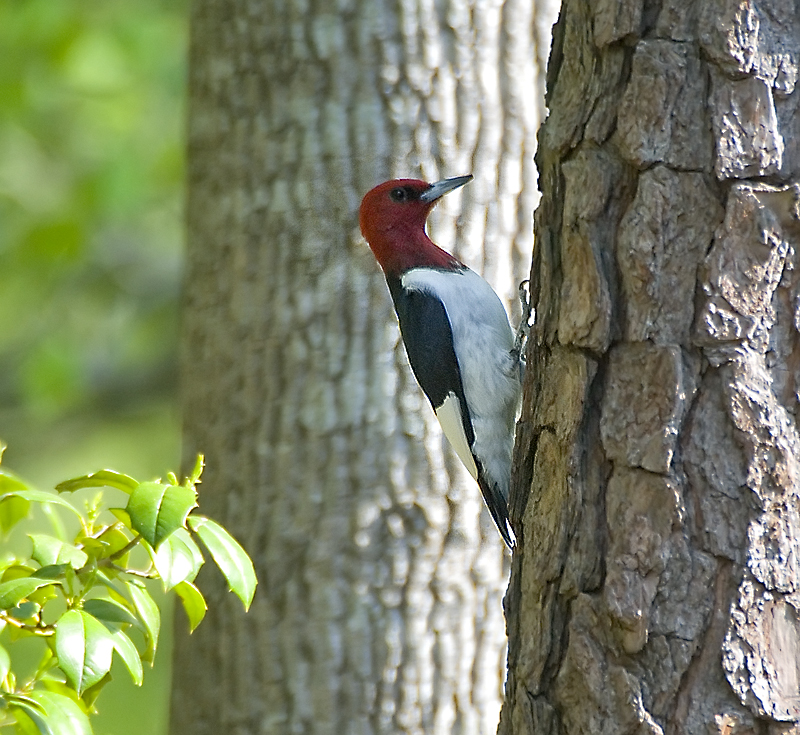
Red-headed woodpecker
Melanerpes erythrocephalus

Acorn woodpecker
Melanerpes formicivorus

Red-bellied woodpecker
Melanerpes carolinus
Frequently asked questions
What does an European green woodpecker sound like?
You can hear 6 recordings of the European green woodpecker on this page, including its alarm call, song and drumming. Most birds have two kinds of vocalisation: songs, which are learned or innate phrases delivered mainly in spring and summer, and calls – brief contact, alarm and begging notes heard all year round.
Is the European green woodpecker endangered?
The IUCN Red List classifies the European green woodpecker as “least concern”.
What family does the European green woodpecker belong to?
The European green woodpecker (Picus viridis) belongs to the family Picidae in the order Piciformes.
Sources & credits
- Green Woodpecker (Picus viridis) (W1CDR0001497 BD6) – CC BY-SA 4.0 · Wikimedia Commons
- Green Woodpecker (Picus viridis) - Frogn, Norway 2021-07-05 (01) by Ryan Hodnett – CC BY-SA 4.0 · Wikimedia Commons
- Alarm call by Alvaro Ortiz Troncoso – CC BY-SA 4.0 · Wikimedia Commons
- Alarm call · Fontaine-le-Comte, Vienne, Nouvelle-Aquitaine, France by Benoît Van Hecke – CC BY-SA 4.0 · Wikimedia Commons
- Song · Fontaine-le-Comte, Vienne, Nouvelle-Aquitaine, France by Benoît Van Hecke – CC BY-SA 4.0 · Wikimedia Commons
- Drumming, song · Paslières, Puy-de-Dôme, Auvergne-Rhône-Alpes, France by Marie-Lan Taÿ Pamart – CC BY-SA 4.0 · Wikimedia Commons
- Wikidata Q166171 – CC0
- Wikipedia: European green woodpecker – CC BY-SA 4.0
- Photo by Sven Teschke , Büdingen – CC BY-SA 2.0