Listen to the great spotted woodpecker
Tip: press play to see the sound's live frequency spectrum in blue over the waveform.
About the great spotted woodpecker
The great spotted woodpecker is a bird in the family Picidae (order Piciformes). Its conservation status on the IUCN Red List is “least concern”. Adults have a wingspan of about 36 cm and weigh around 89 g.
What does the great spotted woodpecker sound like?
Birds produce sound with the syrinx, a vocal organ deep in the chest that can make two independent sounds at once. Songs tend to be long and patterned and are used to hold territory and attract a mate; calls are short signals for contact, alarm and flight.
The recordings here are labelled as call, begging call and flight call. Listen for differences in rhythm, pitch and repetition – the spectrum display makes it easy to see whether a sound is a pure whistle (a thin line), a harsh call (a broad band) or a trill (rapid repeated marks).
From Wikipedia
The great spotted woodpecker (Dendrocopos major) is a medium-sized woodpecker with pied black and white plumage and a red patch on the lower belly. Males and young birds also have red markings on the neck or head. This species is found across the Palearctic including parts of North Africa. Across most of its range it is resident, but in the north some will migrate if the conifer cone crop fails. Some individuals have a tendency to wander, leading to the recolonisation of Ireland in the first decade of the 21st century and to vagrancy to North America. Great spotted woodpeckers chisel into trees to find food or excavate nest holes, and also drum for contact and territorial advertisement; like other woodpeckers, they have anatomical adaptations to manage the physical stresses from the hammering action.
More from the family Picidae

Black woodpecker
Dryocopus martius

Eurasian wryneck
Jynx torquilla

European green woodpecker
Picus viridis

Lesser spotted woodpecker
Dryobates minor

Grey-headed woodpecker
Picus canus

Eurasian three-toed woodpecker
Picoides tridactylus
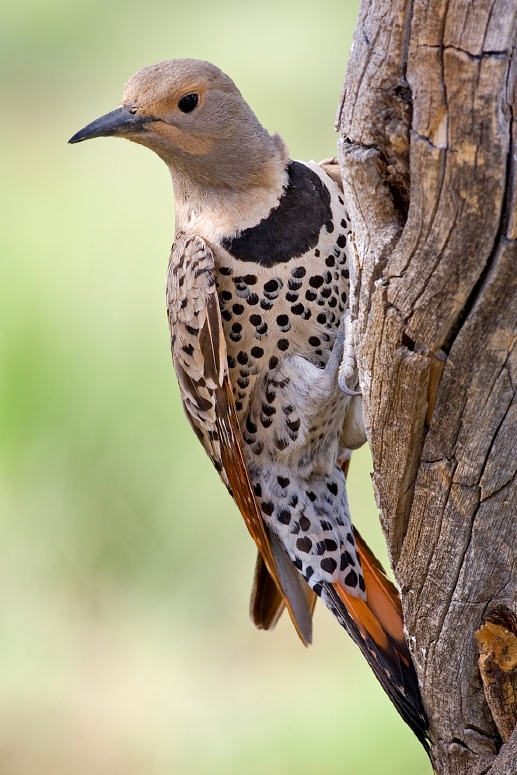
Northern flicker
Colaptes auratus

Pileated woodpecker
Dryocopus pileatus

Black-rumped flameback
Dinopium benghalense
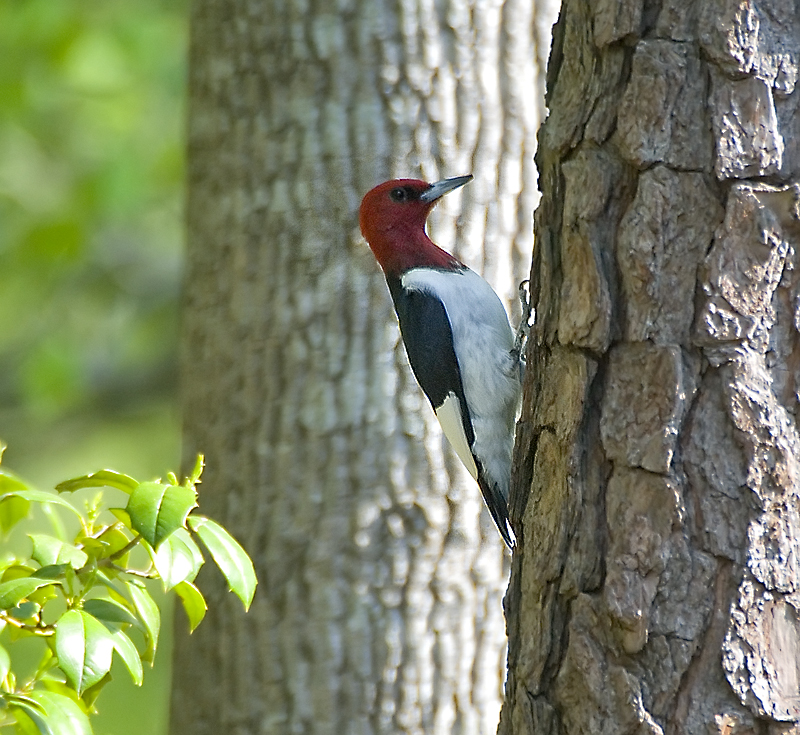
Red-headed woodpecker
Melanerpes erythrocephalus

Acorn woodpecker
Melanerpes formicivorus

Red-bellied woodpecker
Melanerpes carolinus
Frequently asked questions
What does a great spotted woodpecker sound like?
You can hear 6 recordings of the great spotted woodpecker on this page, including its call, begging call and flight call. Birds produce sound with the syrinx, a vocal organ deep in the chest that can make two independent sounds at once.
Is the great spotted woodpecker endangered?
The IUCN Red List classifies the great spotted woodpecker as “least concern”.
What family does the great spotted woodpecker belong to?
The great spotted woodpecker (Dendrocopos major) belongs to the family Picidae in the order Piciformes.
Sources & credits
- Call · Ganzenhoek, Meijendel, Zuid-Holland, Netherlands by Sander Pieterse – CC BY-SA 4.0 · Wikimedia Commons
- Call · Hrubý Šúr, Senec District, Bratislava Region, Slovakia by Alexander Kürthy – CC BY-SA 4.0 · Wikimedia Commons
- Begging call · Mustavuori, Helsinki, Uusimaa, Finland by Hannu Varkki – CC BY-SA 4.0 · Wikimedia Commons
- Flight call · Bonfol, Porrentruy, Jura, Switzerland by Olivier Grimm – CC BY-SA 4.0 · Wikimedia Commons
- Dendrocopos major - Buntspecht - Karausche by MVmath20 – CC BY-SA 4.0 · Wikimedia Commons
- Call · Fontaine-le-Comte, Vienne, Nouvelle-Aquitaine, France by Benoît Van Hecke – CC BY-SA 4.0 · Wikimedia Commons
- Wikidata Q26209 – CC0
- Wikipedia: Great spotted woodpecker – CC BY-SA 4.0
- Photo by Плешков Алексей – CC BY-SA 3.0