Listen to the greater scythebill
Tip: press play to see the sound's live frequency spectrum in blue over the waveform.
About the greater scythebill
The greater scythebill is a bird in the family Furnariidae (order Passeriformes). Its conservation status on the IUCN Red List is “least concern”. Adults weigh around 70 g.
What does the greater scythebill sound like?
Bird vocalisations are usually divided into songs – longer, often complex phrases used to defend territory and attract mates, sung mostly by males in the breeding season – and calls: short, simple sounds for contact, alarm, begging or flight.
The recordings here are labelled as song at dawn. Listen for differences in rhythm, pitch and repetition – the spectrum display makes it easy to see whether a sound is a pure whistle (a thin line), a harsh call (a broad band) or a trill (rapid repeated marks).
From Wikipedia
The greater scythebill (Drymotoxeres pucheranii) is a species of suboscine passerine bird in the subfamily Dendrocolaptinae of the ovenbird family Furnariidae. It is found in Colombia, Ecuador, and Peru.
More from the family Furnariidae

Rufous hornero
Furnarius rufus

Red-billed scythebill
Campylorhamphus trochilirostris

Chestnut-winged hookbill
Ancistrops strigilatus

Pale-legged hornero
Furnarius leucopus

Brown-capped tit-spinetail
Leptasthenura fuliginiceps

Sharp-tailed streamcreeper
Lochmias nematura

Elegant woodcreeper
Xiphorhynchus elegans
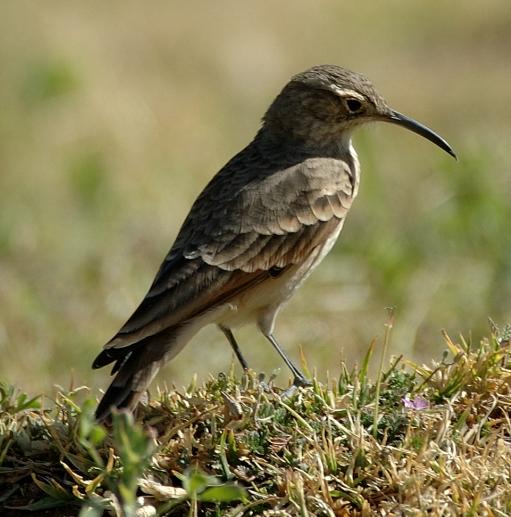
Slender-billed miner
Geositta tenuirostris

Ruddy foliage-gleaner
Clibanornis rubiginosus

Rufous-rumped foliage-gleaner
Philydor erythrocercum

Lesser hornero
Furnarius minor

Orange-fronted plushcrown
Metopothrix aurantiaca
Frequently asked questions
What does a greater scythebill sound like?
You can hear 1 recording of the greater scythebill on this page, including its song at dawn. Bird vocalisations are usually divided into songs – longer, often complex phrases used to defend territory and attract mates, sung mostly by males in the breeding season – and calls: short, simple sounds for contact, alarm, begging or flight.
Is the greater scythebill endangered?
The IUCN Red List classifies the greater scythebill as “least concern”.
What family does the greater scythebill belong to?
The greater scythebill (Drymotoxeres pucheranii) belongs to the family Furnariidae in the order Passeriformes.
Sources & credits
- Song at dawn · Zamora-Chinchipe: camp on Ventanilla-Christopher Parson… by Niels Krabbe – CC BY-SA 4.0 · Wikimedia Commons
- Wikidata Q27075114 – CC0
- Wikipedia: Greater scythebill – CC BY-SA 4.0
- Photo by Marc Athanase Parfait Oeillet Des Murs – Public domain