Listen: Organum examples
Tip: press play to see the sound's live frequency spectrum in blue over the waveform.
About Organum
Organum is a music genre. It is usually classed as a form of polyphony.
From Wikipedia
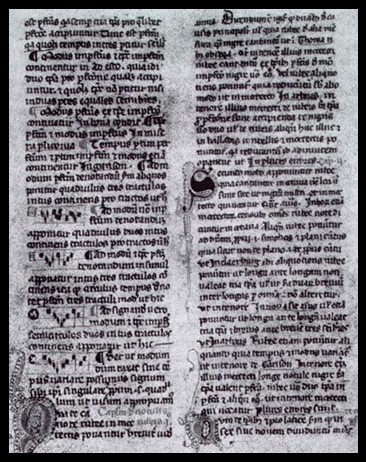
Organum is, in general, a plainchant melody with at least one added voice to enhance the harmony, developed in the Middle Ages. Depending on the mode and form of the chant, a supporting bass line (or bourdon) may be sung on the same text, the melody may be followed in parallel motion (parallel organum), or a combination of both of these techniques may be employed. As no real independent second voice exists, this is a form of heterophony. In its earliest stages, organum involved two musical voices: a Gregorian chant melody, and the same melody transposed by a consonant interval, usually a perfect fifth or fourth. In these cases the composition often began and ended on a unison, the added voice keeping to the initial tone until the first part has reached a fifth or fourth, from where both voices proceeded in parallel harmony, with the reverse process at the end. Organum was originally improvised; while one singer performed a notated melody (the vox principalis), another singer—singing "by ear"—provided the unnotated second melody (the vox organalis). Over time, composers began to write added parts that were not just simple transpositions, thus creating true polyphony.
Genre family tree
Parent genres (↑) and subgenres (↓) of Organum.
Related genres


Frequently asked questions
What is Organum?
Organum is a music genre. It is usually classed as a form of polyphony.
Sources & credits
- Wikidata Q599877 – CC0
- Wikipedia: Organum – CC BY-SA 4.0
- Parallel fourths evoking organum in Debussy's "The Sunken Cathedral" opening 01 by Debussy – Public domain