How the buccin makes its sound
In the Hornbostel–Sachs system, which classifies instruments by how they produce sound, the buccin belongs to the brass (lip-vibrated aerophones): the player's buzzing lips set the air column vibrating – trumpets, horns, trombones, tubas and the didgeridoo.
More broadly it is one of the aerophones (wind instruments), where sound comes from vibrating air.
Players shape its sound through technique and materials; the resonating body filters the raw vibration, boosting some harmonics and damping others.
From Wikipedia
The buccin, or buccin à tête de serpent, is a visually distinctive trombone popularized in military bands in France between 1810 and 1845 which subsequently faded into obscurity. It should not be confused with another instrument also called "buccin", revived in France in 1791 and modeled after the ancient Roman buccina which could deliver only four distinct notes.
In the New Grove Dictionary of Music and Musicians, Arnold Myers devotes but two sentences to this type of buccin: "A form of trombone with a bell terminating in a stylized serpent's or dragon's head, often with a metal tongue, free to flap, protruding. Berlioz scored for buccin in the Kyrie and 'Resurrexit' of his Messe solennelle of 1824."
Other brass

Trumpet
Brass (lip-vibrated aerophones)

Trombone
Brass (lip-vibrated aerophones)

Tuba
Brass (lip-vibrated aerophones)

French horn
Brass (lip-vibrated aerophones)

Brass instrument
Brass (lip-vibrated aerophones)

Vuvuzela
Brass (lip-vibrated aerophones)
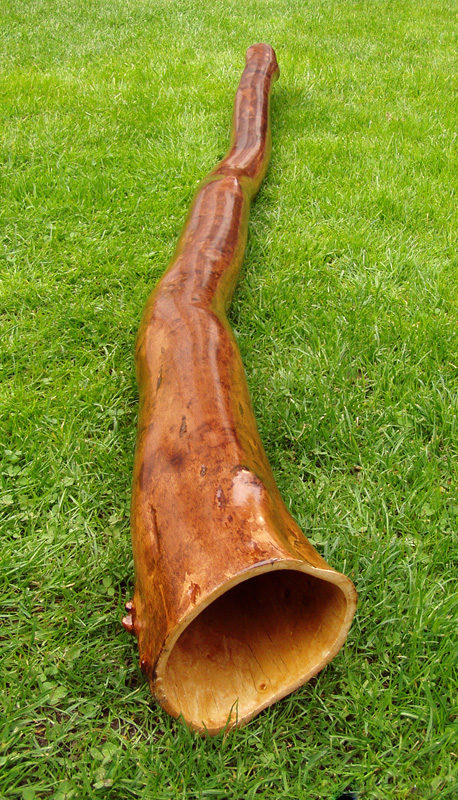
Didgeridoo
Brass (lip-vibrated aerophones)

Cornet
Brass (lip-vibrated aerophones)
Frequently asked questions
What does a buccin sound like?
As one of the brass, its sound comes from the way the player's buzzing lips set the air column vibrating.
What type of instrument is the buccin?
It is classified as brass (lip-vibrated aerophones) (Hornbostel–Sachs 423.22).
Sources & credits
- Wikidata Q4982421 – CC0
- Wikipedia: Buccin – CC BY-SA 4.0
- Image by Enfo – CC BY-SA 3.0