How the contrabass trumpet makes its sound
In the Hornbostel–Sachs system, which classifies instruments by how they produce sound, the contrabass trumpet belongs to the brass (lip-vibrated aerophones): the player's buzzing lips set the air column vibrating – trumpets, horns, trombones, tubas and the didgeridoo.
More broadly it is one of the aerophones (wind instruments), where sound comes from vibrating air.
Press play above and watch the spectrum: the evenly spaced peaks are harmonics, and their relative strength is what gives the instrument its character.
From Wikipedia
The contrabass trumpet is the largest, lowest-pitched, and rarest member of the trumpet family, sounding below the bass trumpet. Only a very small number of instruments exist. The instrument appeared in the mid-20th century and has no orchestral or jazz repertoire. Usually built in 12-foot (12′) F a perfect fourth below the B♭ bass trumpet, it has the same length as the F contrabass trombone, cimbasso, or tuba. When built larger still in 18′ B♭, it is sometimes called a subcontrabass trumpet.
Other brass

Trumpet
Brass (lip-vibrated aerophones)

Trombone
Brass (lip-vibrated aerophones)

Tuba
Brass (lip-vibrated aerophones)

French horn
Brass (lip-vibrated aerophones)

Brass instrument
Brass (lip-vibrated aerophones)

Vuvuzela
Brass (lip-vibrated aerophones)
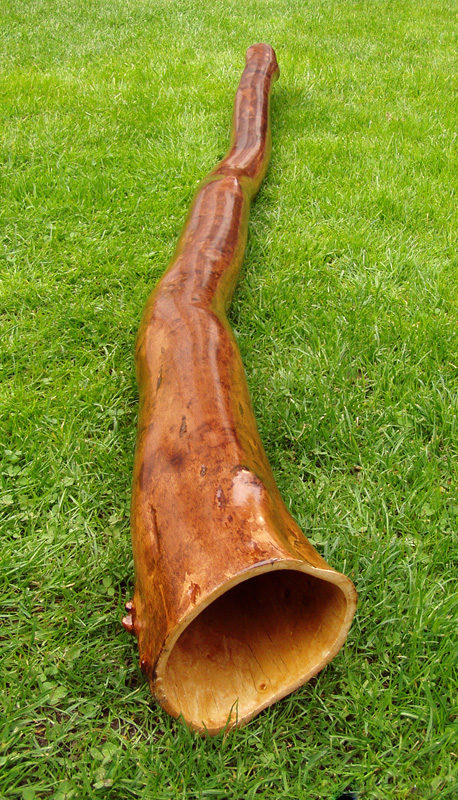
Didgeridoo
Brass (lip-vibrated aerophones)

Cornet
Brass (lip-vibrated aerophones)
Frequently asked questions
What does a contrabass trumpet sound like?
As one of the brass, its sound comes from the way the player's buzzing lips set the air column vibrating.
What type of instrument is the contrabass trumpet?
It is classified as brass (lip-vibrated aerophones) (Hornbostel–Sachs 423.233.2).
Sources & credits
- Wikidata Q5165636 – CC0
- Wikipedia: Contrabass trumpet – CC BY-SA 4.0
- Image by User:Kontrabasstubamann ; colour adjusted by Jonathan Harker – CC BY-SA 4.0