How the hotchiku makes its sound
In the Hornbostel–Sachs system, which classifies instruments by how they produce sound, the hotchiku belongs to the flutes (edge-blown): an air jet is split on a sharp edge, setting the air column vibrating – flutes, recorders, whistles and panpipes.
More broadly it is one of the aerophones (wind instruments), where sound comes from vibrating air.
Players shape its sound through technique and materials; the resonating body filters the raw vibration, boosting some harmonics and damping others.
From Wikipedia
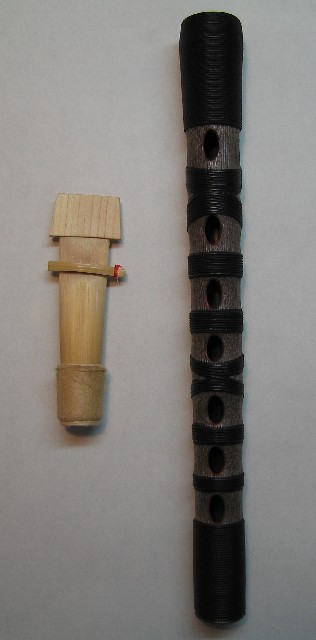
The hotchiku (法竹(ほっちく), "bamboo of [the] dharma"; lit. 'dharma bamboo'), sometimes romanized as hocchiku or hochiku, is a Japanese aerophone, an end-blown bamboo flute, crafted from root sections of bamboo. The bamboo root is cleaned and sanded, resulting in a surface patterned with many small, circular knots where the roots formerly joined the stalk. The same part of the bamboo plant is also used to produce the shakuhachi but, unlike the shakuhachi, the hotchiku's inside (bore) and outside surfaces are left unlacquered, and an inlay is not used in the mouthpiece. The membranes at the nodes inside a hotchiku bore are generally left more intact than those of a shakuhachi, though older komuso shakuhachi also share this trait. Together, these characteristics make for a visibly and audibly raw and organic instrument. Hotchiku are sometimes referred to as jinashi nobekan, meaning "without ji [a paste made of clay and lacquer, used to smooth the bore on modern shakuhachi], one-piece"; hotchiku are not cut in two pieces for crafting or storage, unlike modern shakuhachi that are used as musical instruments.
Other flutes


More instruments from Japan




Frequently asked questions
What does a hotchiku sound like?
As one of the flutes, its sound comes from the way an air jet is split on a sharp edge, setting the air column vibrating.
What type of instrument is the hotchiku?
It is classified as flutes (edge-blown) (Hornbostel–Sachs 421.111.12).
Where does the hotchiku come from?
The hotchiku originates from Japan.
Sources & credits
- Wikidata Q5911047 – CC0
- Wikipedia: Hotchiku – CC BY-SA 4.0
- Image by Sasabuki – CC BY-SA 3.0