Listen to the shakuhachi
Tip: press play to see the sound's live frequency spectrum in blue over the waveform.
How the shakuhachi makes its sound
In the Hornbostel–Sachs system, which classifies instruments by how they produce sound, the shakuhachi belongs to the flutes (edge-blown): an air jet is split on a sharp edge, setting the air column vibrating – flutes, recorders, whistles and panpipes.
More broadly it is one of the aerophones (wind instruments), where sound comes from vibrating air.
Players shape its sound through technique and materials; the resonating body filters the raw vibration, boosting some harmonics and damping others.
From Wikipedia
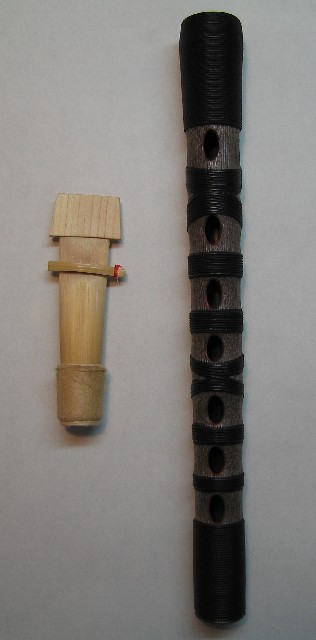
A shakuhachi is a Japanese longitudinal, end-blown flute that is made of bamboo. The bamboo end-blown flute now known as the shakuhachi was developed in Japan in the 16th century and is called the fuke shakuhachi (普化尺八). A bamboo flute known as the kodai shakuhachi (古代尺八, ancient shakuhachi) or gagaku shakuhachi (雅楽尺八) was derived from the Chinese xiao in the Nara period and died out in the 10th century. After a long blank period, the hitoyogiri shakuhachi (一節切尺八) appeared in the 15th century, and then in the 16th century, the fuke shakuhachi was developed in Japan. The fuke shakuhachi flourished in the 18th century during the Edo period, and eventually the hitoyogiri shakuhachi also died out. The fuke shakuhachi developed in Japan is longer and thicker than the kodai shakuhachi and has one finger hole less. It is longer and thicker than hitoyogiri shakuhachi and is superior in volume, range, scale and tone quality. Today, since the shakuhachi generally refers only to fuke shakuhachi, the theory that the shakuhachi is an instrument unique to Japan is widely accepted.
Other flutes


More instruments from Japan




Frequently asked questions
What does a shakuhachi sound like?
Listen to 2 recordings on this page. As one of the flutes, its sound comes from the way an air jet is split on a sharp edge, setting the air column vibrating.
What type of instrument is the shakuhachi?
It is classified as flutes (edge-blown) (Hornbostel–Sachs 421.111.12).
Where does the shakuhachi come from?
The shakuhachi originates from Japan.
Sources & credits
- Shikanotoone by Araki Kodō III (1879–1935) – Public domain · Wikimedia Commons
- Do you Shakuhachi (Antti Luode) by Antti Luode – CC BY 3.0 · Wikimedia Commons
- Wikidata Q524526 – CC0
- Wikipedia: Shakuhachi – CC BY-SA 4.0
- Image – Public domain