How the ryūteki makes its sound
In the Hornbostel–Sachs system, which classifies instruments by how they produce sound, the ryūteki belongs to the flutes (edge-blown): an air jet is split on a sharp edge, setting the air column vibrating – flutes, recorders, whistles and panpipes.
More broadly it is one of the aerophones (wind instruments), where sound comes from vibrating air.
Players shape its sound through technique and materials; the resonating body filters the raw vibration, boosting some harmonics and damping others.
From Wikipedia
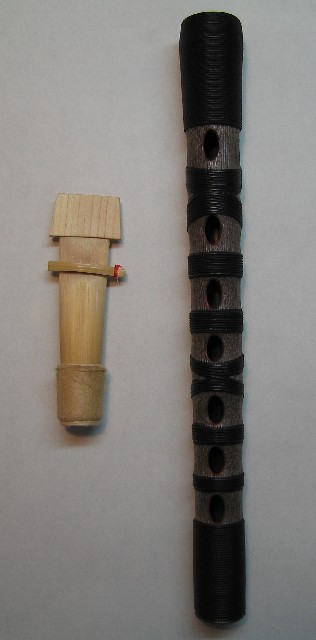
The ryūteki (龍笛; literally "dragon flute") is a Japanese transverse fue made of bamboo. It is used in gagaku, the Shinto classical music associated with Japan's imperial court. The sound of the ryūteki is said to represent the dragons which ascend the skies between the heavenly lights (represented by the shō) and the people of the earth (represented by the hichiriki). The ryūteki is one of the three flutes used in gagaku, in particular to play songs of Chinese style. The pitch is lower than that of the komabue and higher than that of the kagurabue.
The ryūteki is held horizontally, has seven holes, and has a length of 40 centimetres (1 ft 4 in) and an inner diameter of 1.3 centimetres (1⁄2 in). Unlike the western flute, the holes are not covered by the fingertips, rather, the fleshy part of the finger is used. This allows for better control of "half-holing" techniques and chromatic notes, by simply raising the finger slightly above the holes.
Other flutes


More instruments from Japan




Frequently asked questions
What does a ryūteki sound like?
As one of the flutes, its sound comes from the way an air jet is split on a sharp edge, setting the air column vibrating.
What type of instrument is the ryūteki?
It is classified as flutes (edge-blown) (Hornbostel–Sachs 421.121.12).
Where does the ryūteki come from?
The ryūteki originates from Japan.
Sources & credits
- Wikidata Q1760249 – CC0
- Wikipedia: Ryūteki – CC BY-SA 4.0
- Image by The US Library of Congress – Public domain