Listen to the Platypleura divisa
Tip: press play to see the sound's live frequency spectrum in blue over the waveform.
About the Platypleura divisa
The Platypleura divisa is a insect in the family Cicadidae (order Hemiptera).
What does the Platypleura divisa sound like?
Insects make sound mechanically: crickets and grasshoppers rub a scraper against a file (stridulation), cicadas buckle ribbed membranes called tymbals, and bees and mosquitoes hum with their wingbeats.
From Wikipedia
Platypleura divisa is an African cicada first described by Ernst Friedrich Germar, entomologist and professor of mineralogy at Halle, who also studied beetles.
The genus Platypleura occurs widely across Africa and southern Asia. Some of the South African species are remarkable for their endothermic thermoregulation that enables crepuscular signalling, an adaptation that reduces risk of predation and enables a greater range for their calls. In field experiments their maximum body temperature while calling at dusk, was measured at 22 °C above ambient temperature.
Related insects in the genus Platypleura


More from the family Cicadidae

Tanna japonensis
Tanna japonensis
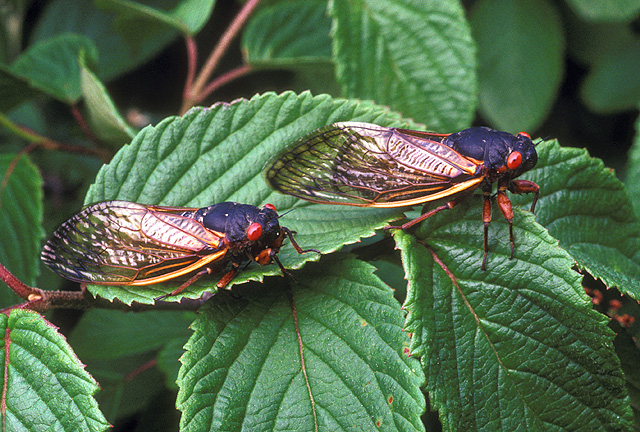
Decim periodical cicada
Magicicada septendecim
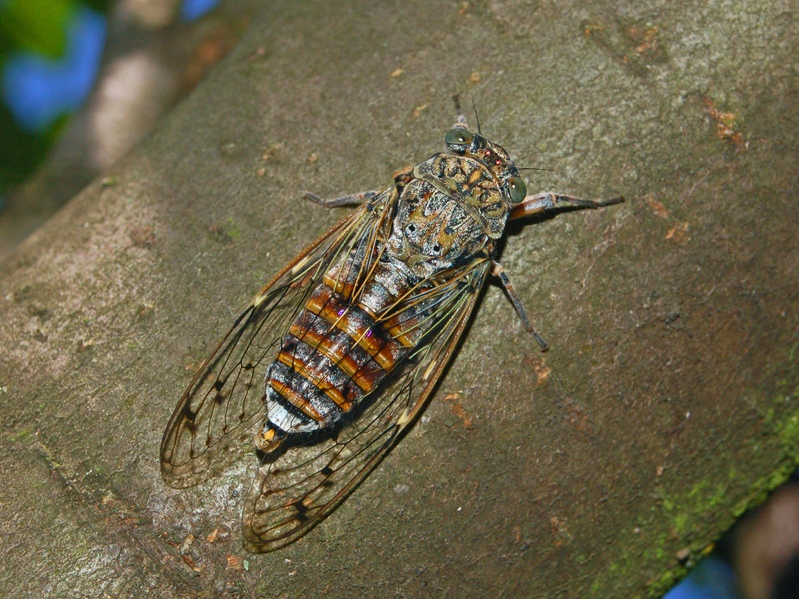
Cicada orni
Cicada orni

Cassini periodical cicada
Magicicada cassini

Graptopsaltria nigrofuscata
Graptopsaltria nigrofuscata

Decula Periodical Cicada
Magicicada septendecula

Sinfonia opalifera
Meimuna opalifera

Chorus cicada
Amphipsalta zelandica

Psaltoda plaga
Psaltoda plaga

Cystosoma saundersii
Cystosoma saundersii
Frequently asked questions
What does a Platypleura divisa sound like?
You can hear 4 recordings of the Platypleura divisa on this page. Insects make sound mechanically: crickets and grasshoppers rub a scraper against a file (stridulation), cicadas buckle ribbed membranes called tymbals, and bees and mosquitoes hum with their wingbeats.
What family does the Platypleura divisa belong to?
The Platypleura divisa (Platypleura divisa) belongs to the family Cicadidae in the order Hemiptera.
Sources & credits
- BioAcoustica MHV 983 P.divisa nr Piet Retief – CC BY 3.0 · Wikimedia Commons
- BioAcoustica MHV 954 P.divisa nr Harrismith (same as MHV 990) – CC BY 3.0 · Wikimedia Commons
- BioAcoustica MHV 989 P.maytenophila nr Jozini – CC BY 3.0 · Wikimedia Commons
- BioAcoustica MHV 982 P.divisa nr Barberton (check ID) – CC BY 3.0 · Wikimedia Commons
- Wikidata Q16988230 – CC0
- Wikipedia: Platypleura divisa – CC BY-SA 4.0
- Photo by W. L. Distant/Horace Knight – Public domain