How the box zither makes its sound
In the Hornbostel–Sachs system, which classifies instruments by how they produce sound, the box zither belongs to the board zithers: strings are stretched across a flat board or box – the family of the piano, harpsichord and hammered dulcimer.
More broadly it is one of the chordophones (string instruments), where sound comes from vibrating strings, amplified by a resonating body.
Players shape its sound through technique and materials; the resonating body filters the raw vibration, boosting some harmonics and damping others.
From Wikipedia
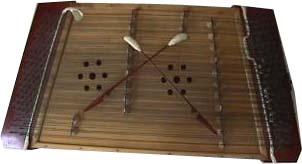
The box zither is a class of stringed instrument in the form of a trapezoid-shaped or rectangular, hollow box. The strings of the box zither are either struck with light hammers or plucked. Among the most popular plucked box zithers are the Arab qānūn and its various derivatives, including the harpsichord (a plucked zither controlled by a keyboard).
Historically various people (Lithuanians, Latvians, Livonians, Estonians, Finns, northwest Russians) have played related box-zither type instruments (the so-called Baltic psaltery) in the south east vicinity of the Baltic Sea for centuries. In the United States the autoharp is a prominent plucked box zither.
Other board zithers




Frequently asked questions
What does a box zither sound like?
As one of the board zithers, its sound comes from the way strings are stretched across a flat board or box.
What type of instrument is the box zither?
It is classified as board zithers (Hornbostel–Sachs 314.122).
Sources & credits
- Wikidata Q4951628 – CC0
- Wikipedia: Box zither – CC BY-SA 4.0
- Image by Thomas Quine – CC BY 2.0