How the clavichord makes its sound
In the Hornbostel–Sachs system, which classifies instruments by how they produce sound, the clavichord belongs to the board zithers: strings are stretched across a flat board or box – the family of the piano, harpsichord and hammered dulcimer.
More broadly it is one of the chordophones (string instruments), where sound comes from vibrating strings, amplified by a resonating body.
Press play above and watch the spectrum: the evenly spaced peaks are harmonics, and their relative strength is what gives the instrument its character.
From Wikipedia
The clavichord is a stringed rectangular keyboard instrument that was used largely in the Late Middle Ages, through the Renaissance, Baroque and Classical eras.
Historically, it was mostly used as a practice instrument and as an aid to composition, not being loud enough for larger performances. The clavichord produces sound by striking brass or iron strings with small metal blades called tangents. Vibrations are transmitted through the bridge(s) to the soundboard.
Other board zithers


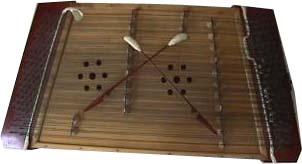


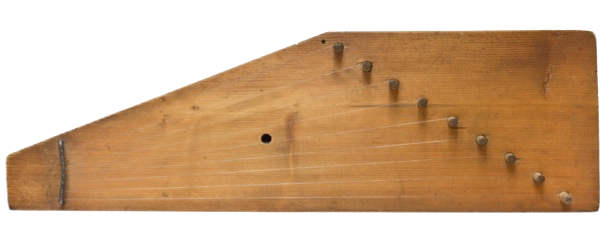
More instruments from Italy


Frequently asked questions
What does a clavichord sound like?
As one of the board zithers, its sound comes from the way strings are stretched across a flat board or box.
What type of instrument is the clavichord?
It is classified as board zithers (Hornbostel–Sachs 314.122-4-8).
Where does the clavichord come from?
The clavichord originates from Italy.
Sources & credits
- Wikidata Q191823 – CC0
- Wikipedia: Clavichord – CC BY-SA 4.0
- Image by User InFairness on en.wikipedia – CC BY-SA 3.0