Listen to the kantele
Tip: press play to see the sound's live frequency spectrum in blue over the waveform.
How the kantele makes its sound
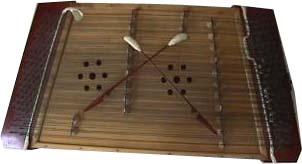
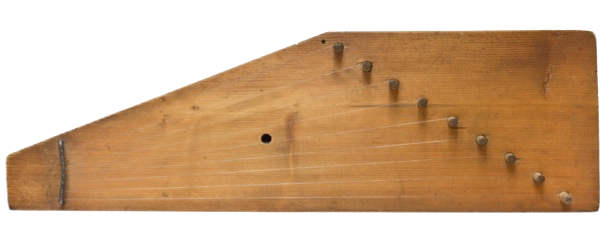
In the Hornbostel–Sachs system, which classifies instruments by how they produce sound, the kantele belongs to the board zithers: strings are stretched across a flat board or box – the family of the piano, harpsichord and hammered dulcimer.
More broadly it is one of the chordophones (string instruments), where sound comes from vibrating strings, amplified by a resonating body.
Its timbre – the colour that lets you tell it apart from other instruments playing the same note – comes from the mix of overtones its body and resonator emphasise.
From Wikipedia
A kantele or kannel is a traditional Finnish and Karelian plucked string instrument (chordophone). It belongs to the southeast Baltic box zither family known as the Baltic psaltery, along with the Estonian kannel, the Latvian kokles, the Lithuanian kanklės, and the Russian gusli.
Other board zithers



More instruments from Finland

Frequently asked questions
What does a kantele sound like?
Listen to 1 recording on this page. As one of the board zithers, its sound comes from the way strings are stretched across a flat board or box.
What type of instrument is the kantele?
It is classified as board zithers (Hornbostel–Sachs 314.122-5).
Where does the kantele come from?
The kantele originates from Finland.
Sources & credits
- DIY kantele sample raw by Olli Niemitalo – CC0 1.0 · Wikimedia Commons
- Wikidata Q145840 – CC0
- Wikipedia: Kantele – CC BY-SA 4.0
- Image by Paul Lenz – CC BY-SA 3.0