How the chakhe makes its sound
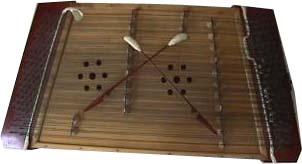
In the Hornbostel–Sachs system, which classifies instruments by how they produce sound, the chakhe belongs to the board zithers: strings are stretched across a flat board or box – the family of the piano, harpsichord and hammered dulcimer.
More broadly it is one of the chordophones (string instruments), where sound comes from vibrating strings, amplified by a resonating body.
Press play above and watch the spectrum: the evenly spaced peaks are harmonics, and their relative strength is what gives the instrument its character.
From Wikipedia
The chakhe (Thai: จะเข้, pronounced [tɕā.kʰêː], or krapeu (Khmer: ក្រពើ), also called takhe (Khmer: តាខេ), also called ja-khe, is a fretted floor zither or lute with three strings. The Thai and the Khmer versions of the instrument are virtually identical.
It is made of hardwood in a stylized crocodile shape, approximately 20 cm high and 130–132 cm long. The "head" portion is 52 cm long, 28 cm wide and 9–12 cm deep; the "tail" portion 81 cm long and 11.5 cm wide. It has eleven (takhe) or twelve (krapeu) raised frets made of bamboo, ivory, bone, or wood, graduated between 2 and 3.5 cm in height, which are affixed to the fretboard with wax or glue. Its highest two strings are made of silk yarn, catgut, or nylon, while the lowest is made of metal. They are tuned C–G–c. The instrument is usually supported by three or five legs.
Other board zithers




Frequently asked questions
What does a chakhe sound like?
As one of the board zithers, its sound comes from the way strings are stretched across a flat board or box.
What type of instrument is the chakhe?
It is classified as board zithers (Hornbostel–Sachs 314.122).
Where does the chakhe come from?
The chakhe originates from Cambodia, Laos and Thailand.
Sources & credits
- Wikidata Q5068327 – CC0
- Wikipedia: Chakhe – CC BY-SA 4.0
- Image by Paul_012 – CC BY-SA 3.0