Listen to the güiro
Tip: press play to see the sound's live frequency spectrum in blue over the waveform.
How the güiro makes its sound
In the Hornbostel–Sachs system, which classifies instruments by how they produce sound, the güiro belongs to the shaken and scraped idiophones: the body is shaken, scraped or split – rattles, maracas and guiros.
More broadly it is one of the idiophones, where the solid body of the instrument itself vibrates, without strings or a stretched membrane.
Press play above and watch the spectrum: the evenly spaced peaks are harmonics, and their relative strength is what gives the instrument its character.
From Wikipedia
The güiro is a percussion instrument consisting of an open-ended, hollow gourd with parallel notches cut in one side. It is played by rubbing a stick or tines (see photo) along the notches to produce a zipper-like ratchet sound.
The güiro is commonly used in Cuban, Puerto Rican, and other forms of Latin American music, and plays a key role in the typical rhythm section of important genres like son, trova and salsa. Playing the güiro usually requires both long and short sounds, made by scraping up and down in long or short strokes.
Other shaken and scraped idiophones

Tambourine
Shaken and scraped idiophones

Maraca
Shaken and scraped idiophones

Music box
Shaken and scraped idiophones

Sistrum
Shaken and scraped idiophones

Angklung
Shaken and scraped idiophones

Jingle bell
Shaken and scraped idiophones

Ratchet
Shaken and scraped idiophones
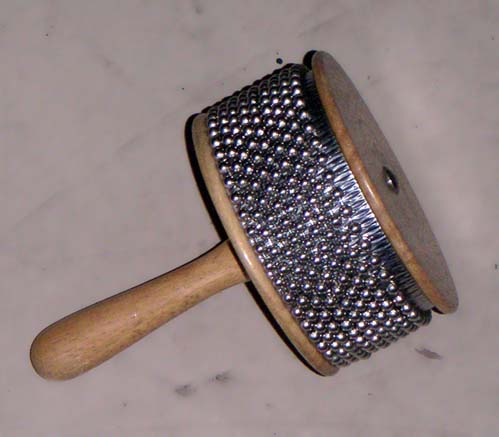
Cabasa
Shaken and scraped idiophones
Frequently asked questions
What does a güiro sound like?
Listen to 1 recording on this page. As one of the shaken and scraped idiophones, its sound comes from the way the body is shaken, scraped or split.
What type of instrument is the güiro?
It is classified as shaken and scraped idiophones (Hornbostel–Sachs 112.23).
Sources & credits
- Guiro by Freddythehat at English Wikipedia – Public domain · Wikimedia Commons
- Wikidata Q2237198 – CC0
- Wikipedia: Güiro – CC BY-SA 4.0
- Image by Enfo – CC BY-SA 3.0