How the sistrum makes its sound
In the Hornbostel–Sachs system, which classifies instruments by how they produce sound, the sistrum belongs to the shaken and scraped idiophones: the body is shaken, scraped or split – rattles, maracas and guiros.
More broadly it is one of the idiophones, where the solid body of the instrument itself vibrates, without strings or a stretched membrane.
Press play above and watch the spectrum: the evenly spaced peaks are harmonics, and their relative strength is what gives the instrument its character.
From Wikipedia
A sistrum (plural: sistra; from Latin sistrum, from Greek σεῖστρον seistron of the same meaning; literally "that which is being shaken", from σείειν seiein, "to shake") is a musical instrument of the percussion family, a form of rattle, used most notably by the ancient Egyptians. It consists of a handle and a U-shaped metal frame, made of brass or bronze and ranging from 30 to 76 cm (12–30 in) in width. The frame supports sliding metal cross-bars, which may hold metal rings. When shaken, the small rings or loops of thin metal on its movable crossbars produce a sound that can vary from a soft clank to a loud jangling. Its name in the ancient Egyptian language was sekhem (sḫm) or sesheshet (sššt) because of the sound it made when it rattled. The ancient Egyptian sistrum had important associations with religious and ritualistic practices concerning various musical and joyful deities.
Other shaken and scraped idiophones

Tambourine
Shaken and scraped idiophones

Maraca
Shaken and scraped idiophones

Music box
Shaken and scraped idiophones

Angklung
Shaken and scraped idiophones

Jingle bell
Shaken and scraped idiophones

Ratchet
Shaken and scraped idiophones

Güiro
Shaken and scraped idiophones
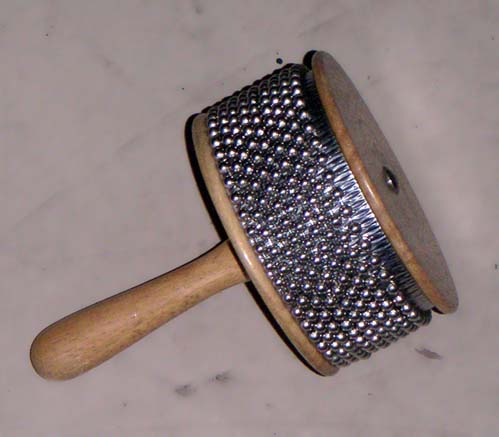
Cabasa
Shaken and scraped idiophones
Frequently asked questions
What does a sistrum sound like?
As one of the shaken and scraped idiophones, its sound comes from the way the body is shaken, scraped or split.
What type of instrument is the sistrum?
It is classified as shaken and scraped idiophones (Hornbostel–Sachs 112.112).
Where does the sistrum come from?
The sistrum originates from Ancient Egypt.
Sources & credits
- Wikidata Q426948 – CC0
- Wikipedia: Sistrum – CC BY-SA 4.0
- Image by Lalupa – CC BY-SA 3.0