How the ratchet makes its sound
In the Hornbostel–Sachs system, which classifies instruments by how they produce sound, the ratchet belongs to the shaken and scraped idiophones: the body is shaken, scraped or split – rattles, maracas and guiros.
More broadly it is one of the idiophones, where the solid body of the instrument itself vibrates, without strings or a stretched membrane.
Players shape its sound through technique and materials; the resonating body filters the raw vibration, boosting some harmonics and damping others.
From Wikipedia
A ratchet or rattle, more specifically, cog rattle is a musical instrument of the percussion family and a warning/signaling device. It operates on the principle of the ratchet device, using a gearwheel and a stiff board mounted on a handle, which rotates freely. Variants include the gragger (Yiddish: גראַגער) used in Judaism, the crotalus, the rapach, and the raganella.
Other shaken and scraped idiophones

Tambourine
Shaken and scraped idiophones

Maraca
Shaken and scraped idiophones

Music box
Shaken and scraped idiophones

Sistrum
Shaken and scraped idiophones

Angklung
Shaken and scraped idiophones

Jingle bell
Shaken and scraped idiophones

Güiro
Shaken and scraped idiophones
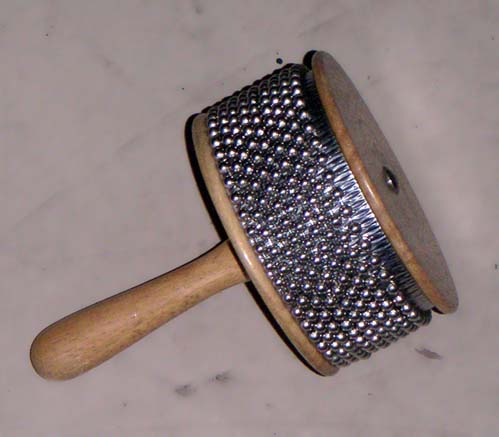
Cabasa
Shaken and scraped idiophones
Frequently asked questions
What does a ratchet sound like?
As one of the shaken and scraped idiophones, its sound comes from the way the body is shaken, scraped or split.
What type of instrument is the ratchet?
It is classified as shaken and scraped idiophones (Hornbostel–Sachs 112.24).
Sources & credits
- Wikidata Q954753 – CC0
- Wikipedia: Ratchet (instrument) – CC BY-SA 4.0
- Image by Yoninah – Public domain