How the maraca makes its sound
In the Hornbostel–Sachs system, which classifies instruments by how they produce sound, the maraca belongs to the shaken and scraped idiophones: the body is shaken, scraped or split – rattles, maracas and guiros.
More broadly it is one of the idiophones, where the solid body of the instrument itself vibrates, without strings or a stretched membrane.
Press play above and watch the spectrum: the evenly spaced peaks are harmonics, and their relative strength is what gives the instrument its character.
From Wikipedia
A maraca, sometimes called shaker or chac-chac, is a rattle which appears in many genres of Caribbean and Latin music, as well as rock music on occasion. It is shaken by a handle and usually played as part of a pair. A maraca player in the Spanish language is called a maraquero.
Other shaken and scraped idiophones

Tambourine
Shaken and scraped idiophones

Music box
Shaken and scraped idiophones

Sistrum
Shaken and scraped idiophones

Angklung
Shaken and scraped idiophones

Jingle bell
Shaken and scraped idiophones

Ratchet
Shaken and scraped idiophones

Güiro
Shaken and scraped idiophones
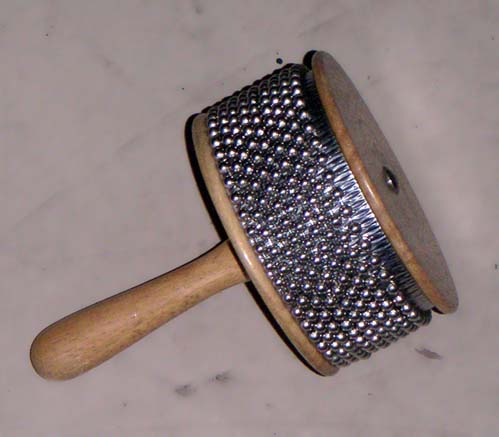
Cabasa
Shaken and scraped idiophones
Frequently asked questions
What does a maraca sound like?
As one of the shaken and scraped idiophones, its sound comes from the way the body is shaken, scraped or split.
What type of instrument is the maraca?
It is classified as shaken and scraped idiophones (Hornbostel–Sachs 112.13).
Sources & credits
- Wikidata Q39777 – CC0
- Wikipedia: Maraca – CC BY-SA 4.0
- Image by Dan Moi – CC BY-SA 2.0