How the gusli makes its sound
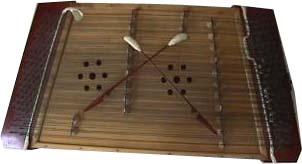
In the Hornbostel–Sachs system, which classifies instruments by how they produce sound, the gusli belongs to the board zithers: strings are stretched across a flat board or box – the family of the piano, harpsichord and hammered dulcimer.
More broadly it is one of the chordophones (string instruments), where sound comes from vibrating strings, amplified by a resonating body.
Press play above and watch the spectrum: the evenly spaced peaks are harmonics, and their relative strength is what gives the instrument its character.
From Wikipedia
The gusli or husla (Ukrainian: гусла, husla) is the oldest East Slavic multi-string plucked instrument, belonging to the zither family, due to its strings being parallel to its resonance board. Its roots lie in Veliky Novgorod in the Novgorodian Republic. It has its relatives in Europe and throughout the world: kantele/kannel in Finland, kannel in Estonia, kanklės in Lithuania, kokles in Latvia, Zither in Germany, citera in the Czech Republic, and psalterium in France. Furthermore, the kanun has been found in Arabic countries, and the autoharp, in the United States. It is also related to such ancient instruments as Chinese gu zheng, which has a thousand-year history, and its Japanese relative koto. A stringed musical instrument called guslim is listed as one of the Me in ancient Sumer.
Other board zithers




Frequently asked questions
What does a gusli sound like?
As one of the board zithers, its sound comes from the way strings are stretched across a flat board or box.
What type of instrument is the gusli?
It is classified as board zithers (Hornbostel–Sachs 314.122-5).
Where does the gusli come from?
The gusli originates from Kievan Rus'.
Sources & credits
- Wikidata Q1147128 – CC0
- Wikipedia: Gusli – CC BY-SA 4.0
- Image by Kamenskiyan – CC BY-SA 3.0