How the kannel makes its sound
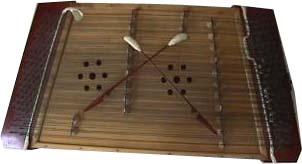
In the Hornbostel–Sachs system, which classifies instruments by how they produce sound, the kannel belongs to the board zithers: strings are stretched across a flat board or box – the family of the piano, harpsichord and hammered dulcimer.
More broadly it is one of the chordophones (string instruments), where sound comes from vibrating strings, amplified by a resonating body.
Press play above and watch the spectrum: the evenly spaced peaks are harmonics, and their relative strength is what gives the instrument its character.
From Wikipedia
Kannel is an Estonian plucked string instrument (chordophone) belonging to the Baltic box zither family known as the Baltic psaltery along with Finnish kantele, Latvian kokles, Lithuanian kanklės, and Russian gusli. The Estonian kannel has a variety of traditional tunings. In Estonia, studying the kannel has made a resurgence after some years of decline.
Other board zithers




Frequently asked questions
What does a kannel sound like?
As one of the board zithers, its sound comes from the way strings are stretched across a flat board or box.
What type of instrument is the kannel?
It is classified as board zithers (Hornbostel–Sachs 314.122-5).
Where does the kannel come from?
The kannel originates from Estonia.
Sources & credits
- Wikidata Q3732881 – CC0
- Wikipedia: Kannel (instrument) – CC BY-SA 4.0
- Image by Adeliine – CC BY-SA 3.0