How the kusle makes its sound
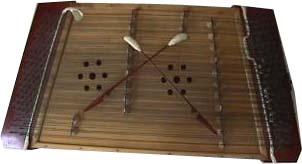
In the Hornbostel–Sachs system, which classifies instruments by how they produce sound, the kusle belongs to the board zithers: strings are stretched across a flat board or box – the family of the piano, harpsichord and hammered dulcimer.
More broadly it is one of the chordophones (string instruments), where sound comes from vibrating strings, amplified by a resonating body.
Its timbre – the colour that lets you tell it apart from other instruments playing the same note – comes from the mix of overtones its body and resonator emphasise.
From Wikipedia
Kusle (Meadow Mari: кӱсле; Northwestern Mari: кӹсле, кӹслӓ) or karsh (Meadow and Northwestern Mari: кӓрш) is a Mari plucked string instrument (chordophone). It has 12-20 strings and is shaped like a semi-circle. The instrument is played in the lap, with both hands, and was played on some occasions such as ritual sacrifices, and to accompany dancing. Kusle is described as resembling the Russian gusli or the Finnish kantele.
Organologist Anthony Baines noted in 1969, regarding the medieval Russian gusli: "...and the instrument has latterly been revived, notably in the Mari province by the Volga".
Other board zithers




Frequently asked questions
What does a kusle sound like?
As one of the board zithers, its sound comes from the way strings are stretched across a flat board or box.
What type of instrument is the kusle?
It is classified as board zithers (Hornbostel–Sachs 314.122-5).