How the square piano makes its sound
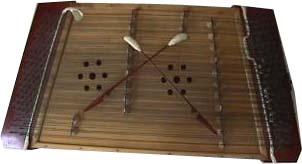
In the Hornbostel–Sachs system, which classifies instruments by how they produce sound, the square piano belongs to the board zithers: strings are stretched across a flat board or box – the family of the piano, harpsichord and hammered dulcimer.
More broadly it is one of the chordophones (string instruments), where sound comes from vibrating strings, amplified by a resonating body.
Its timbre – the colour that lets you tell it apart from other instruments playing the same note – comes from the mix of overtones its body and resonator emphasise.
From Wikipedia
The square piano is a type of piano that has horizontal strings arranged diagonally across the rectangular case above the hammers and with the keyboard set in the long side, with the sounding board above a cavity in the short side. It is variously attributed to Silbermann and Frederici and was improved by Petzold and Babcock. The English and Viennese square pianos were built in many different designs, including within the action as well as general appearance, from roughly 1760. Because of the competitive industry and relative youth of the instrument design itself, experimentation ensued in the early years, creating a range of moderators (sound-altering effects) and other technical devices (knee levers; hand stops) not seen today.
Other board zithers




Frequently asked questions
What does a square piano sound like?
As one of the board zithers, its sound comes from the way strings are stretched across a flat board or box.
What type of instrument is the square piano?
It is classified as board zithers (Hornbostel–Sachs 314.122).