How the Taishōgoto makes its sound
In the Hornbostel–Sachs system, which classifies instruments by how they produce sound, the Taishōgoto belongs to the board zithers: strings are stretched across a flat board or box – the family of the piano, harpsichord and hammered dulcimer.
More broadly it is one of the chordophones (string instruments), where sound comes from vibrating strings, amplified by a resonating body.
Players shape its sound through technique and materials; the resonating body filters the raw vibration, boosting some harmonics and damping others.
From Wikipedia
The taishōgoto (大正琴), or Nagoya harp, is a Japanese stringed musical instrument. The name derives from the Taishō period (1912–1926) when the instrument first appeared. It is essentially a Keyboard Psalmodikon with multiple strings.
There are 4 types available: soprano has 5 or 6 strings, alto has 4 or 5 strings, tenor and bass have 1 or 2 strings.
Other board zithers


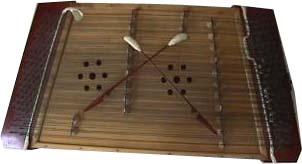


Frequently asked questions
What does the Taishōgoto sound like?
As one of the board zithers, its sound comes from the way strings are stretched across a flat board or box.
What type of instrument is the Taishōgoto?
It is classified as board zithers (Hornbostel–Sachs 314.122-8).
Sources & credits
- Wikidata Q1166068 – CC0
- Wikipedia: Taishōgoto – CC BY-SA 4.0
- Image by ja:User:Suguri F (すぐり) – CC BY-SA 3.0