How the yamatogoto makes its sound
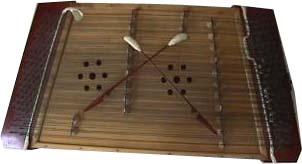
In the Hornbostel–Sachs system, which classifies instruments by how they produce sound, the yamatogoto belongs to the board zithers: strings are stretched across a flat board or box – the family of the piano, harpsichord and hammered dulcimer.
More broadly it is one of the chordophones (string instruments), where sound comes from vibrating strings, amplified by a resonating body.
Its timbre – the colour that lets you tell it apart from other instruments playing the same note – comes from the mix of overtones its body and resonator emphasise.
From Wikipedia
The yamatogoto (大和琴 / やまとごと), also called wagon (和琴 / わごん) and azumagoto (東琴 / あずまごと), is a six- or seven-stringed plucked bridge zither which, unlike the koto and other stringed instruments, is believed to be truly native to Japan, and not imported from mainland Asia. Both names translate literally to "Japanese stringed instrument."
Other board zithers




Frequently asked questions
What does a yamatogoto sound like?
As one of the board zithers, its sound comes from the way strings are stretched across a flat board or box.
What type of instrument is the yamatogoto?
It is classified as board zithers (Hornbostel–Sachs 314.122).
Sources & credits
- Wikidata Q3571466 – CC0
- Wikipedia: Yamatogoto – CC BY-SA 4.0
- Image by 国立文化財機構 – CC BY 4.0