How the yanggeum makes its sound
In the Hornbostel–Sachs system, which classifies instruments by how they produce sound, the yanggeum belongs to the board zithers: strings are stretched across a flat board or box – the family of the piano, harpsichord and hammered dulcimer.
More broadly it is one of the chordophones (string instruments), where sound comes from vibrating strings, amplified by a resonating body.
Players shape its sound through technique and materials; the resonating body filters the raw vibration, boosting some harmonics and damping others.
From Wikipedia
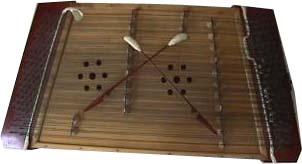
The yanggeum (Korean: 양금; Hanja: 洋琴) is a traditional Korean string instrument. It is a hammered dulcimer. Unlike other traditional Korean instruments (most of which have silk strings), the yanggeum has metal strings. It is played by striking the strings with a bamboo stick.
Yanggeum means a stringed instrument of the West (yang). The yanggeum is also called seoyanggeum ("Western stringed instrument") or gura cheolsageum (歐邏鐵絲琴,"European metal stringed instrument"). The yanggeum's origin is based on a South Asian instrument called the santoor. It was introduced to Korea in the 18th century via China. Its body is flat and trapezoidal, with seven sets of four metal strings. The right hand strikes the strings with a thin bamboo strip.
Other board zithers




Frequently asked questions
What does a yanggeum sound like?
As one of the board zithers, its sound comes from the way strings are stretched across a flat board or box.
What type of instrument is the yanggeum?
It is classified as board zithers (Hornbostel–Sachs 314.122).
Sources & credits
- Wikidata Q16256860 – CC0
- Wikipedia: Yanggeum – CC BY-SA 4.0
- Image by 국립중앙박물관 e뮤지엄 – KOGL Type 1