How the bowed clavier makes its sound
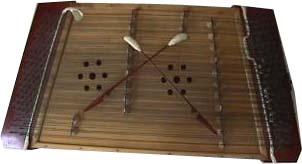
In the Hornbostel–Sachs system, which classifies instruments by how they produce sound, the bowed clavier belongs to the board zithers: strings are stretched across a flat board or box – the family of the piano, harpsichord and hammered dulcimer.
More broadly it is one of the chordophones (string instruments), where sound comes from vibrating strings, amplified by a resonating body.
Press play above and watch the spectrum: the evenly spaced peaks are harmonics, and their relative strength is what gives the instrument its character.
From Wikipedia
The bowed clavier (Bogenclavier, Streichklavier or Geigenwerk in German) is a keyboard instrument strung with gut strings, the tone of which is produced by a steadily revolving, well rosined cylinder powered by a foot pedal, a mechanism similar to that found in the hurdy-gurdy.
The Geigenwerck was illustrated and described by Michael Praetorius in his treatise on musical instruments Syntagma Musicum II, in the section De Organograhia, published 1614–20 in Germany.
Other board zithers




Frequently asked questions
What does a bowed clavier sound like?
As one of the board zithers, its sound comes from the way strings are stretched across a flat board or box.
What type of instrument is the bowed clavier?
It is classified as board zithers (Hornbostel–Sachs 314.122-71).
Sources & credits
- Wikidata Q372308 – CC0
- Wikipedia: Bowed clavier – CC BY-SA 4.0
- Image by Gérard – CC BY-SA 4.0