How the contrabass clarinet makes its sound
In the Hornbostel–Sachs system, which classifies instruments by how they produce sound, the contrabass clarinet belongs to the single-reed instruments: a single reed beats against a mouthpiece – clarinets and saxophones.
More broadly it is one of the aerophones (wind instruments), where sound comes from vibrating air.
Press play above and watch the spectrum: the evenly spaced peaks are harmonics, and their relative strength is what gives the instrument its character.
From Wikipedia
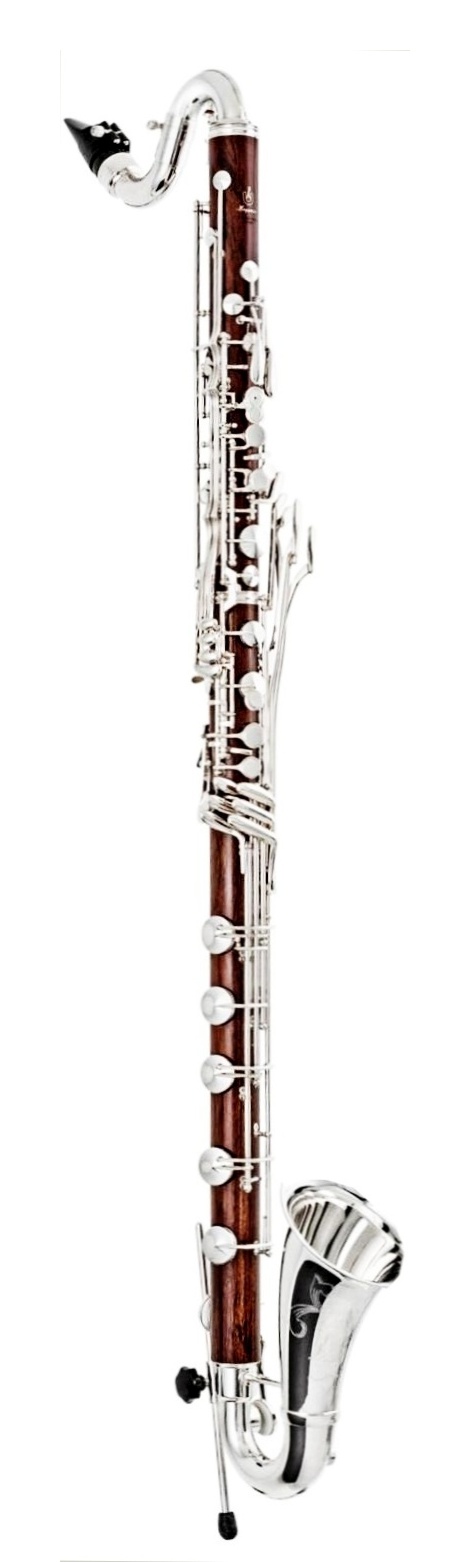
The contrabass clarinet (or pedal clarinet after the pedals of pipe organs) is an uncommonly used member of the clarinet family. Modern contrabass clarinets are transposing instruments pitched in B♭, sounding two octaves lower than the common B♭ soprano clarinet and one octave below the bass clarinet. Some contrabass clarinet models have extra keys to extend the range down to low written E♭3, D3 or C3. This gives a tessitura written range, notated in treble clef, of C3 – F6, which sounds B♭0 – E♭4. Some early instruments were pitched in C; Arnold Schoenberg's Fünf Orchesterstücke specifies a contrabass clarinet in A, but there is no evidence such an instrument has ever existed.
The smaller E♭ contra-alto clarinet is sometimes referred to as the "E♭ contrabass clarinet" and is pitched one octave lower than the E♭ alto clarinet.
Other single-reed instruments




Frequently asked questions
What does a contrabass clarinet sound like?
As one of the single-reed instruments, its sound comes from the way a single reed beats against a mouthpiece.
What type of instrument is the contrabass clarinet?
It is classified as single-reed instruments (Hornbostel–Sachs 422.211.2).
Sources & credits
- Wikidata Q2731509 – CC0
- Wikipedia: Contrabass clarinet – CC BY-SA 4.0
- Image by Conn-Selmer, Inc. – CC BY-SA 4.0