How the folding harpsichord makes its sound
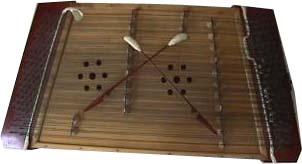
In the Hornbostel–Sachs system, which classifies instruments by how they produce sound, the folding harpsichord belongs to the board zithers: strings are stretched across a flat board or box – the family of the piano, harpsichord and hammered dulcimer.
More broadly it is one of the chordophones (string instruments), where sound comes from vibrating strings, amplified by a resonating body.
Players shape its sound through technique and materials; the resonating body filters the raw vibration, boosting some harmonics and damping others.
From Wikipedia
The folding harpsichord was a kind of harpsichord meant for travel. Since it could be folded up into a fairly compact space, it was more easily transported than a conventional harpsichord. The folding took place on hinges and was in the longitudinal dimension, preserving the tension on the strings. The folded instrument formed a package about the size of a large suitcase.
It is sometimes called by its French equivalent, clavecin brisé, which means "broken harpsichord," or by the German term, Reisecembalo, which means "travel harpsichord."
Other board zithers




Frequently asked questions
What does a folding harpsichord sound like?
As one of the board zithers, its sound comes from the way strings are stretched across a flat board or box.
What type of instrument is the folding harpsichord?
It is classified as board zithers (Hornbostel–Sachs 314.122-6-8).
Sources & credits
- Wikidata Q1098974 – CC0
- Wikipedia: Folding harpsichord – CC BY-SA 4.0
- Image by Gérard Janot – CC BY-SA 3.0