How the guitar zither makes its sound
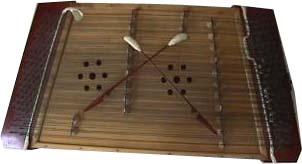
In the Hornbostel–Sachs system, which classifies instruments by how they produce sound, the guitar zither belongs to the board zithers: strings are stretched across a flat board or box – the family of the piano, harpsichord and hammered dulcimer.
More broadly it is one of the chordophones (string instruments), where sound comes from vibrating strings, amplified by a resonating body.
Players shape its sound through technique and materials; the resonating body filters the raw vibration, boosting some harmonics and damping others.
From Wikipedia
The guitar zither (also chord zither, fretless zither, mandolin zither or harp zither) is a musical instrument consisting of a sound-box with two sets of unstopped strings. One set of strings is tuned to the diatonic, chromatic, or partially chromatic scale and the other set is tuned to make the various chords in the principal key of the melody strings.
First patented May 29, 1894 by Friederich Menzenhauer (1858-1937), the guitar zither came into use in the late 19th century and was widely mass-produced in the United States and in Germany by Menzenhauer and later by Oscar Schmidt Inc., the Phonoharp Company, and others'.
Other board zithers




Frequently asked questions
What does a guitar zither sound like?
As one of the board zithers, its sound comes from the way strings are stretched across a flat board or box.
What type of instrument is the guitar zither?
It is classified as board zithers (Hornbostel–Sachs 314.122).