How the hammered dulcimer makes its sound
In the Hornbostel–Sachs system, which classifies instruments by how they produce sound, the hammered dulcimer belongs to the board zithers: strings are stretched across a flat board or box – the family of the piano, harpsichord and hammered dulcimer.
More broadly it is one of the chordophones (string instruments), where sound comes from vibrating strings, amplified by a resonating body.
Press play above and watch the spectrum: the evenly spaced peaks are harmonics, and their relative strength is what gives the instrument its character.
From Wikipedia
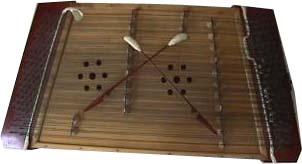
The hammered dulcimer (also called the hammer dulcimer) is a percussion-string instrument which consists of strings typically stretched over a trapezoidal resonant sound board. The hammered dulcimer is set before the musician, who in more traditional styles may sit cross-legged on the floor, or in a more modern style may stand or sit at a wooden support with legs. The player holds a small spoon-shaped mallet or hammer in each hand to strike the strings. The Graeco-Roman word dulcimer ('sweet song') derives from the Latin dulcis ('sweet') and the Greek melos (μέλος, 'song'). The dulcimer, in which the strings are beaten with small hammers, originated from the psaltery, in which the strings are plucked.
Other board zithers




Questions people ask
Real questions from the Stack Exchange community – follow a link to read the discussion.
- What is the best way to mic a hammered dulcimer? · Sound Design SE
Frequently asked questions
What does a hammered dulcimer sound like?
As one of the board zithers, its sound comes from the way strings are stretched across a flat board or box.
What type of instrument is the hammered dulcimer?
It is classified as board zithers (Hornbostel–Sachs 314.122).
Sources & credits
- Wikidata Q1588017 – CC0
- Wikipedia: Hammered dulcimer – CC BY-SA 4.0
- Image – Public domain