Listen to the Hammond organ
Tip: press play to see the sound's live frequency spectrum in blue over the waveform.
How the Hammond organ makes its sound
In the Hornbostel–Sachs system, which classifies instruments by how they produce sound, the Hammond organ belongs to the electrophones: sound is produced or shaped electronically – synthesizers, the theremin and electric organs.
Its timbre – the colour that lets you tell it apart from other instruments playing the same note – comes from the mix of overtones its body and resonator emphasise.
From Wikipedia
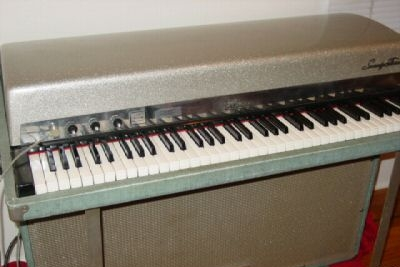
The Hammond organ is an electric organ invented by Laurens Hammond and John M. Hanert, first manufactured in 1935. Multiple models have been produced, most of which use sliding drawbars to vary sounds. Until 1975, sound was created from rotating a metal tonewheel near an electromagnetic pickup, and amplifying the electric signal into a speaker cabinet. The organ is commonly used with the Leslie speaker.
Other electrophones


Frequently asked questions
What does the Hammond organ sound like?
Listen to 1 recording on this page. As one of the electrophones, its sound comes from the way sound is produced or shaped electronically.
What type of instrument is the Hammond organ?
It is classified as electrophones (Hornbostel–Sachs 521).
Sources & credits
- LezlieCabinetSequence – Public domain · Wikimedia Commons
- Wikidata Q105891 – CC0
- Wikipedia: Hammond organ – CC BY-SA 4.0
- Image by it:user:Salli – CC BY-SA 3.0