How the ikembe makes its sound
In the Hornbostel–Sachs system, which classifies instruments by how they produce sound, the ikembe belongs to the plucked idiophones (lamellophones): flexible tongues or lamellae are plucked – the mbira, kalimba, music box and jaw harp.
More broadly it is one of the idiophones, where the solid body of the instrument itself vibrates, without strings or a stretched membrane.
Its timbre – the colour that lets you tell it apart from other instruments playing the same note – comes from the mix of overtones its body and resonator emphasise.
From Wikipedia
Ikembe, is a type of musical instrument of the lamellaphone group, common amongst the people of Rwanda, Burundi and the Congo. The instrument consists of several iron lamellae, fixed to a rectangular wooden soundbox.
In Swahili the word imba means song. Kuimba means to sing, as in the phrase "nitakwenda kuimba" (I go to sing). Swahili, as in many languages, uses a type of binomial nomenclature to create new words to describe unfamiliar or new objects, occurrences or people, based on existing words or concepts. By combining part of the word for mother = ma with the word for song = imba using r as a connector we come up with the word marimba = mother of song. We can then extrapolate from the research of A.M. Jones, quoted by Osborne that ka = small combined with the word imba = song should mean little mother of song.
Other plucked idiophones

Jew's harp
Plucked idiophones (lamellophones)

Mbira
Plucked idiophones (lamellophones)
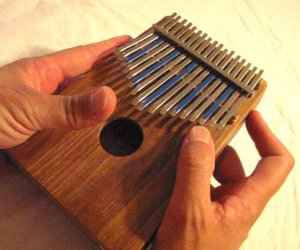
Lamellophone
Plucked idiophones (lamellophones)

Đàn môi
Plucked idiophones (lamellophones)

Kouxian
Plucked idiophones (lamellophones)

Ōtsuzumi
Plucked idiophones (lamellophones)
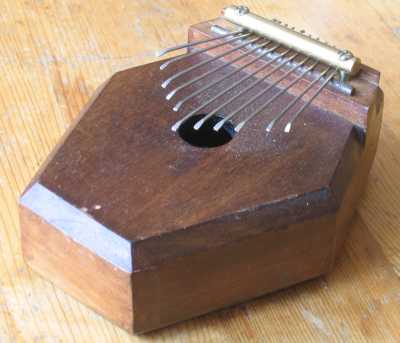
Kalimba
Plucked idiophones (lamellophones)
Agidigbo
Plucked idiophones (lamellophones)
Frequently asked questions
What does an ikembe sound like?
As one of the plucked idiophones, its sound comes from the way flexible tongues or lamellae are plucked.
What type of instrument is the ikembe?
It is classified as plucked idiophones (lamellophones) (Hornbostel–Sachs 122.1).
Sources & credits
- Wikidata Q5995811 – CC0
- Wikipedia: Ikembe – CC BY-SA 4.0
- Image by 19Tarrestnom65 – CC BY-SA 4.0