How the kouxian makes its sound
In the Hornbostel–Sachs system, which classifies instruments by how they produce sound, the kouxian belongs to the plucked idiophones (lamellophones): flexible tongues or lamellae are plucked – the mbira, kalimba, music box and jaw harp.
More broadly it is one of the idiophones, where the solid body of the instrument itself vibrates, without strings or a stretched membrane.
Press play above and watch the spectrum: the evenly spaced peaks are harmonics, and their relative strength is what gives the instrument its character.
From Wikipedia
Kouxian (Chinese: 口弦; pinyin: kǒuxián; lit. 'mouth string') is a general Chinese term for any variety of jaw harp. The jaw harp is a plucked idiophone in which the lamella is mounted in a small frame, and the player's open mouth serves as a resonance chamber.
Chinese jaw harps may comprise multiple idiophones that are lashed together at one end and spread in a fan formation. They may be made from bamboo or a metal alloy, such as brass. Modern kouxian with three or more idiophones might be tuned to the first few tones of the minor pentatonic scale.
Other plucked idiophones

Jew's harp
Plucked idiophones (lamellophones)

Mbira
Plucked idiophones (lamellophones)
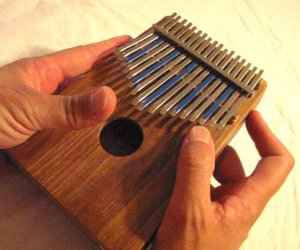
Lamellophone
Plucked idiophones (lamellophones)

Đàn môi
Plucked idiophones (lamellophones)

Ōtsuzumi
Plucked idiophones (lamellophones)
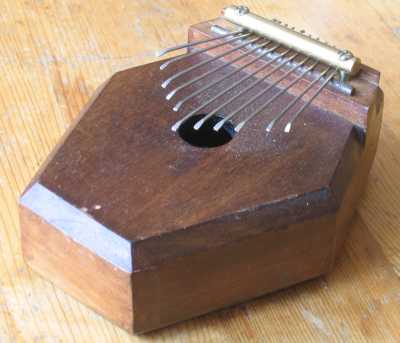
Kalimba
Plucked idiophones (lamellophones)
Agidigbo
Plucked idiophones (lamellophones)

Ikembe
Plucked idiophones (lamellophones)
Frequently asked questions
What does a kouxian sound like?
As one of the plucked idiophones, its sound comes from the way flexible tongues or lamellae are plucked.
What type of instrument is the kouxian?
It is classified as plucked idiophones (lamellophones) (Hornbostel–Sachs 121.2).
Sources & credits
- Wikidata Q6434803 – CC0
- Wikipedia: Kouxian – CC BY-SA 4.0
- Image by Codell – Public domain