How the lamellophone makes its sound
In the Hornbostel–Sachs system, which classifies instruments by how they produce sound, the lamellophone belongs to the plucked idiophones (lamellophones): flexible tongues or lamellae are plucked – the mbira, kalimba, music box and jaw harp.
More broadly it is one of the idiophones, where the solid body of the instrument itself vibrates, without strings or a stretched membrane.
Press play above and watch the spectrum: the evenly spaced peaks are harmonics, and their relative strength is what gives the instrument its character.
From Wikipedia
A lamellophone (also lamellaphone or linguaphone) is a member of the family of musical instruments that makes its sound by a thin vibrating plate called a lamella or tongue, which is fixed at one end and has the other end free. When the musician depresses the free end of a plate with a finger or fingernail, and then allows the finger to slip off, the released plate vibrates. An instrument may have a single tongue (such as a Jew's harp) or a series of multiple tongues (such as a mbira thumb piano).
Linguaphone comes from the Latin root lingua meaning 'tongue', (i.e., a long thin plate that is fixed only at one end). Lamellophone comes from the Latin word lamella for 'small metal plate', and the Greek word φωνή phonē for 'sound, voice'.
Other plucked idiophones

Jew's harp
Plucked idiophones (lamellophones)

Mbira
Plucked idiophones (lamellophones)

Đàn môi
Plucked idiophones (lamellophones)

Kouxian
Plucked idiophones (lamellophones)

Ōtsuzumi
Plucked idiophones (lamellophones)
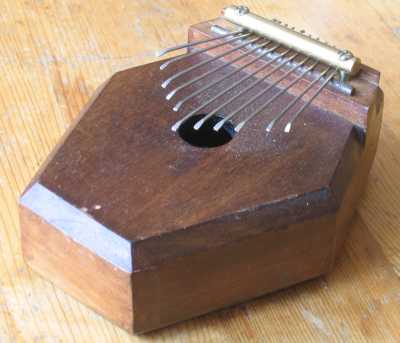
Kalimba
Plucked idiophones (lamellophones)
Agidigbo
Plucked idiophones (lamellophones)

Ikembe
Plucked idiophones (lamellophones)
Frequently asked questions
What does a lamellophone sound like?
As one of the plucked idiophones, its sound comes from the way flexible tongues or lamellae are plucked.
What type of instrument is the lamellophone?
It is classified as plucked idiophones (lamellophones) (Hornbostel–Sachs 12).
Sources & credits
- Wikidata Q936762 – CC0
- Wikipedia: Lamellophone – CC BY-SA 4.0
- Image by Markholdaway at English Wikipedia – CC BY-SA 3.0